Striptease: Difference between revisions
CSV import |
CSV import |
||
| Line 31: | Line 31: | ||
{{stub}} | {{stub}} | ||
<gallery> | |||
File:Striptease.jpg|Striptease | |||
File:Baker_Banana_2.jpg|Baker Banana 2 | |||
File:1720_Der_spanische_teutsche_und_niederlaendische_Krieg_p238.png|1720 Der spanische teutsche und niederlaendische Krieg p238 | |||
File:La_Fontaine_-_Tales_and_Novels_in_verse_-_v2_p130.jpg|La Fontaine - Tales and Novels in verse - v2 p130 | |||
File:Mata_Hari_15.jpg|Mata Hari 15 | |||
File:BrunetteStagFilm.ogv|Brunette Stag Film | |||
File:Trapeze_Disrobing_Act_(1901).webm|Trapeze Disrobing Act (1901) | |||
File:Windmill-Theatre.jpg|Windmill Theatre | |||
File:Pole_dancer_04.jpg|Pole dancer 04 | |||
File:Pole_dancer_03.jpg|Pole dancer 03 | |||
File:ChippendalesLasVegas.jpg|Chippendales Las Vegas | |||
File:IndigoBlueMissExoticWorld2006.jpg|Indigo Blue Miss Exotic World 2006 | |||
</gallery> | |||
Latest revision as of 21:12, 23 February 2025
Striptease is a form of theatrical performance and entertainment that involves a performer undressing. While the act may include nudity, it does not necessarily have to. The purpose of a striptease is often to sexually excite or entertain an audience.
History[edit]
The origins of striptease as a performance art are disputed and various dates and occasions have been given from ancient Babylonia to 20th century America. The term "striptease" was first recorded in 1938, though "stripping", in the sense of women removing clothing to sexually excite men, seems to go back to at least the late 19th century.
Performance[edit]
Striptease involves a slow, sensuous undressing, with the audience urging the stripper to remove more clothing. The stripper may prolong the undressing with delaying tactics such as the wearing of additional clothes or putting clothes or hands in front of just undressed body parts such as the breasts or genitalia. The emphasis is on the act of undressing along with sexually suggestive movement, rather than the state of being undressed.
Legal and cultural aspects[edit]
Striptease and public nudity have been subject to legal and cultural prohibitions and other aesthetic considerations and taboos. Restrictions on venues may be through venue licensing requirements and constraints and a wide variety of national and local laws.
See also[edit]
References[edit]
<references />
 | |
|---|---|
 |
 |
-
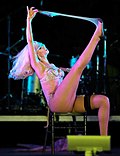 Striptease
 -
 Baker Banana 2
 -
 1720 Der spanische teutsche und niederlaendische Krieg p238
 -
 La Fontaine - Tales and Novels in verse - v2 p130
 -
 Mata Hari 15
 -
 Brunette Stag Film
 -
 Trapeze Disrobing Act (1901)
 -
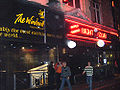 Windmill Theatre
 -
 Pole dancer 04
 -
 Pole dancer 03
 -
 Chippendales Las Vegas
 -
 Indigo Blue Miss Exotic World 2006


