Biological pump: Difference between revisions
CSV import |
CSV import |
||
| Line 36: | Line 36: | ||
{{Ocean-stub}} | {{Ocean-stub}} | ||
{{climate change-stub}} | {{climate change-stub}} | ||
<gallery> | |||
File:WOA05_GLODAP_invt_aco2_AYool.png|WOA05 GLODAP invt aco2 AYool | |||
File:Vertically_integrated_anthropogenic_dissolved_inorganic_carbon_1990s_(GLODAP).png|Vertically integrated anthropogenic dissolved inorganic carbon 1990s (GLODAP) | |||
File:Oceanic_Food_Web.jpg|Oceanic Food Web | |||
File:Components_of_the_biological_pump_2018.jpg|Components of the biological pump 2018 | |||
File:Components_of_the_biological_pump.png|Components of the biological pump | |||
File:Size_and_classification_of_marine_particles.png|Size and classification of marine particles | |||
File:Marine_connections_between_the_living_and_the_nonliving.png|Marine connections between the living and the nonliving | |||
File:Fate_of_DOM_in_the_ocean.png|Fate of DOM in the ocean | |||
</gallery> | |||
Latest revision as of 21:09, 23 February 2025
Biological Pump
The biological pump, also known as the marine biological pump, is a process that transports carbon from the Earth's surface to the deep ocean. This process plays a crucial role in the global carbon cycle, as it helps to regulate the concentration of carbon dioxide in the Earth's atmosphere.
Overview[edit]
The biological pump is driven by the production of organic matter by photosynthetic organisms in the surface ocean, primarily phytoplankton. These organisms convert carbon dioxide and sunlight into organic matter and oxygen through the process of photosynthesis. When these organisms die or are consumed by other organisms, the organic matter they contain can sink to the deep ocean, where it is sequestered from the atmosphere for hundreds to thousands of years.
Components of the Biological Pump[edit]
The biological pump consists of two main components: the soft-tissue pump and the carbonate pump.
Soft-Tissue Pump[edit]
The soft-tissue pump involves the production of organic matter by photosynthetic organisms in the surface ocean, and its subsequent transport to the deep ocean. This process begins with the uptake of carbon dioxide by phytoplankton, which convert it into organic matter through photosynthesis. When these organisms die or are consumed by other organisms, the organic matter they contain can sink to the deep ocean as marine snow.
Carbonate Pump[edit]
The carbonate pump involves the production of calcium carbonate shells by certain types of plankton, such as coccolithophores and foraminifera. When these organisms die, their shells sink to the deep ocean, where they can contribute to the formation of carbonate sediments.
Role in the Carbon Cycle[edit]
The biological pump plays a crucial role in the global carbon cycle. By transporting carbon from the surface ocean to the deep ocean, it helps to regulate the concentration of carbon dioxide in the Earth's atmosphere. This process is particularly important in the context of climate change, as it can help to mitigate the increase in atmospheric carbon dioxide concentrations caused by human activities.
See Also[edit]

This article is a oceanography stub. You can help WikiMD by expanding it!
This climate change related article is a stub. You can help WikiMD by expanding it.
-
 WOA05 GLODAP invt aco2 AYool
 -
Vertically integrated anthropogenic dissolved inorganic carbon 1990s (GLODAP)
-
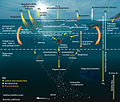 Oceanic Food Web
 -
 Components of the biological pump 2018
 -
 Components of the biological pump
 -
 Size and classification of marine particles
 -
 Marine connections between the living and the nonliving
 -
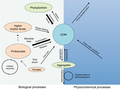 Fate of DOM in the ocean
.png)


