Phytoplankton: Difference between revisions
CSV import Tags: mobile edit mobile web edit |
CSV import |
||
| Line 30: | Line 30: | ||
{{stub}} | {{stub}} | ||
== Phytoplankton == | |||
<gallery> | |||
File:Diatoms_through_the_microscope.jpg|Diatoms through the microscope | |||
File:CSIRO_ScienceImage_4203_A_bluegreen_algae_species_Cylindrospermum_sp_under_magnification.jpg|A bluegreen algae species Cylindrospermum sp under magnification | |||
File:Global_phytoplankton_distribution_-_NASA.webm|Global phytoplankton distribution - NASA | |||
File:Cycling_of_marine_phytoplankton.png|Cycling of marine phytoplankton | |||
File:Luminescent_beaches_in_Chabahar3.jpg|Luminescent beaches in Chabahar | |||
File:Spring_Bloom_Colors_the_Pacific_Near_Hokkaido.jpg|Spring Bloom Colors the Pacific Near Hokkaido | |||
File:Cwall99_lg.jpg|Cwall99 | |||
File:NASA_satellite_view_of_Southern_Ocean_phytoplankton_bloom_(crop).jpg|NASA satellite view of Southern Ocean phytoplankton bloom | |||
File:Competing_scientific_hypothesis_of_plankton_variability.png|Competing scientific hypothesis of plankton variability | |||
File:Plankton_satellite_image.jpg|Plankton satellite image | |||
File:Global_phytoplankton_species_richness_and_turnover.jpg|Global phytoplankton species richness and turnover | |||
</gallery> | |||
Latest revision as of 20:57, 23 February 2025
Phytoplankton are the autotrophic (self-feeding) components of the plankton community and a key part of oceans, seas and freshwater basin ecosystems. The name comes from the Greek words φυτόν (phyton), meaning 'plant', and πλαγκτός (planktos), meaning 'wanderer' or 'drifter'.
Phytoplankton obtain energy through the process of photosynthesis and must therefore live in the well-lit surface layer (termed the euphotic zone) of an ocean, sea, lake, or other body of water. They account for about half of all photosynthetic activity on Earth.
Classification[edit]
Phytoplankton encompass a wide array of unicellular organisms, some of which are no longer classified within the plant kingdom. They can be broadly divided into two groups: cyanobacteria (also called blue-green algae) and algae.
Role in the food chain[edit]
Phytoplankton serve as the base of the aquatic food web, providing an essential ecological function for all aquatic life. They are consumed by zooplankton, small fish and whales.
Role in the carbon cycle[edit]
Phytoplankton play a crucial role in the carbon cycle, they take in carbon dioxide, and release oxygen as a by-product, which other organisms, such as humans, depend on for survival.
Threats[edit]
Phytoplankton populations can be negatively impacted by climate change, ocean acidification, and water pollution. These threats can lead to algal blooms, which can have harmful effects on other marine life and the environment.
See also[edit]
 | |
|---|---|
 |
 |
Phytoplankton[edit]
-
 Diatoms through the microscope
 -
 A bluegreen algae species Cylindrospermum sp under magnification
 -
 Global phytoplankton distribution - NASA
 -
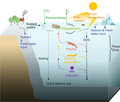 Cycling of marine phytoplankton
 -
 Luminescent beaches in Chabahar
 -
 Spring Bloom Colors the Pacific Near Hokkaido
 -
 Cwall99
 -
 NASA satellite view of Southern Ocean phytoplankton bloom
 -
 Competing scientific hypothesis of plankton variability
 -
 Plankton satellite image
 -
 Global phytoplankton species richness and turnover


.jpg)


