Herpetic gingivostomatitis: Difference between revisions
CSV import |
CSV import |
||
| Line 52: | Line 52: | ||
[[Category:Viral diseases]] | [[Category:Viral diseases]] | ||
[[Category:Oral pathology]] | [[Category:Oral pathology]] | ||
<gallery> | |||
File:Herpesgingiva.JPG|Herpesgingiva | |||
File:Herpes_Gingivalis.tiff|Herpes Gingivalis | |||
</gallery> | |||
Revision as of 20:56, 23 February 2025
Herpetic Gingivostomatitis

Herpetic gingivostomatitis is an infection of the oral cavity caused by the Herpes simplex virus (HSV). It is the most common clinical manifestation of primary HSV-1 infection in children, although it can also occur in adults. The condition is characterized by inflammation of the gums (gingiva) and the mucous membranes of the mouth (stomatitis), leading to painful sores and ulcers.
Clinical Presentation
The onset of herpetic gingivostomatitis is often sudden, with symptoms including:
- Fever
- Irritability
- Painful oral lesions
- Swollen and bleeding gums
- Difficulty eating and drinking
The oral lesions typically appear as small vesicles that rupture to form shallow ulcers. These ulcers can be found on the gums, tongue, inner cheeks, and roof of the mouth.
Pathophysiology
Herpetic gingivostomatitis is caused by the Herpes simplex virus type 1 (HSV-1), although HSV-2 can also be responsible in some cases. The virus is transmitted through direct contact with infected saliva or lesions. After initial infection, the virus travels to the sensory ganglia, where it remains latent. Reactivation of the virus can lead to recurrent infections, often presenting as cold sores or herpes labialis.
Diagnosis
Diagnosis of herpetic gingivostomatitis is primarily clinical, based on the characteristic appearance of the oral lesions and the patient's history. Laboratory tests, such as viral culture or polymerase chain reaction (PCR), can be used to confirm the presence of HSV.
Treatment
Treatment of herpetic gingivostomatitis focuses on relieving symptoms and preventing dehydration. Management may include:
- Adequate hydration
- Pain relief with analgesics
- Antiviral medications such as acyclovir or valacyclovir in severe cases
Prognosis
The prognosis for herpetic gingivostomatitis is generally good, with symptoms typically resolving within 1 to 2 weeks. However, the virus remains in the body and can reactivate, leading to recurrent episodes.
Prevention
Preventive measures include avoiding direct contact with infected individuals and practicing good hygiene. In some cases, antiviral prophylaxis may be considered for individuals with frequent recurrences.
Related Pages
| Infectious diseases | ||||||||||
|---|---|---|---|---|---|---|---|---|---|---|
This infectious diseases related article is a stub.
|
-
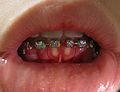 Herpesgingiva
 -
 Herpes Gingivalis

