Roast goose: Difference between revisions
CSV import |
CSV import |
||
| Line 29: | Line 29: | ||
[[Category:Cantonese cuisine]] | [[Category:Cantonese cuisine]] | ||
{{food-stub}} | {{food-stub}} | ||
<gallery> | |||
File:Roasted_goose.jpg|Roasted goose | |||
File:Roastedgoose.jpg|Roasted goose | |||
File:Christmas_goose_(Weihnachtsgans).jpg|Christmas goose (Weihnachtsgans) | |||
</gallery> | |||
Latest revision as of 21:40, 20 February 2025
Roast Goose is a traditional dish, particularly popular in European and Asian cuisines. The dish involves the preparation and roasting of a whole goose.
History[edit]
Roast goose has a long history, with roots in both Roman and Medieval times. It was a popular dish for feasts and celebrations, and is still a common sight on tables during Christmas and Thanksgiving in many Western countries. In Asia, particularly in places like Hong Kong, roast goose is a staple in many restaurants and is often served with a variety of sauces and accompaniments.
Preparation[edit]
The preparation of roast goose involves several steps. First, the goose is thoroughly cleaned and plucked. Some recipes call for the goose to be brined or marinated for several hours or even days. The goose is then stuffed, often with a mixture of fruits, vegetables, and herbs, though the exact ingredients can vary widely. The stuffed goose is then roasted in an oven until the skin is crispy and the meat is cooked through.
Variations[edit]
There are many variations of roast goose, depending on the region and personal preference. In Germany, for example, the goose is often stuffed with apples, onions, chestnuts, and prunes. In China, the goose might be marinated in a mixture of soy sauce, honey, and spices before being roasted.
Cultural Significance[edit]
Roast goose holds a significant place in many cultures. In British culture, it is traditionally associated with Michaelmas, a Christian feast day. In Germany, it is often served on St. Martin's Day. In China, roast goose is a common dish in Cantonese cuisine, and is often served at celebrations and festivals.
See Also[edit]

-
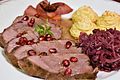 Roasted goose
 -
 Roasted goose
 -
 Christmas goose (Weihnachtsgans)


.jpg)
