Saffron bun: Difference between revisions
CSV import |
CSV import |
||
| Line 29: | Line 29: | ||
[[Category:Christmas food]] | [[Category:Christmas food]] | ||
{{food-stub}} | {{food-stub}} | ||
<gallery> | |||
File:Saffron_bun_20051213_001.jpg|Saffron bun | |||
File:LucyBun.jpg|Lucy Bun | |||
File:Cornish_Saffron_Buns.jpg|Cornish Saffron Buns | |||
</gallery> | |||
Latest revision as of 21:36, 20 February 2025
Saffron bun
A Saffron bun, also known as a Saint Lucia bun or lussekatt in Scandinavia, is a rich, spiced bun that is traditionally enjoyed during the Christmas season, particularly on Saint Lucia's Day (December 13). The bun is characterized by its vibrant yellow color, which is derived from the use of saffron, a precious and expensive spice.
History[edit]
The origins of the saffron bun can be traced back to Sweden, where it is known as a lussekatt. The tradition of baking these buns is closely tied to the celebration of Saint Lucia's Day, a festival of light that marks the beginning of the Christmas season in Scandinavia. The buns are often shaped into a figure eight or an 'S' shape, which is said to represent Saint Lucia's eyes.
Ingredients and Preparation[edit]
The primary ingredient in a saffron bun is saffron, which gives the bun its distinctive yellow color and unique flavor. Other ingredients typically include flour, sugar, yeast, milk, butter, and egg. Some variations may also include raisins or currants.
To prepare saffron buns, the saffron is first steeped in hot, but not boiling, milk. This helps to extract the color and flavor from the spice. The saffron-infused milk is then combined with the other ingredients to form a dough, which is left to rise. Once the dough has risen, it is shaped into buns, which are then baked until golden.
Cultural Significance[edit]
In Sweden, saffron buns are traditionally served on Saint Lucia's Day, which is celebrated on December 13. On this day, it is customary for the eldest daughter in a family to dress in a white gown with a red sash and a crown of candles, and to serve saffron buns to the rest of the family. This tradition is said to commemorate Saint Lucia, a 4th-century martyr who brought food to Christians hiding in the catacombs.
In addition to Sweden, saffron buns are also popular in other Scandinavian countries, as well as in Cornwall, England, where they are known as 'Cornish saffron buns' or 'tea treat buns'. In Cornwall, these buns are often served with clotted cream and jam.
See Also[edit]

-
 Saffron bun
 -
 Lucy Bun
 -
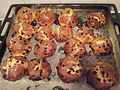 Cornish Saffron Buns


