Saumagen: Difference between revisions
CSV import Tags: mobile edit mobile web edit |
CSV import |
||
| Line 18: | Line 18: | ||
[[Category:Stuffed dishes]] | [[Category:Stuffed dishes]] | ||
{{food-stub}} | {{food-stub}} | ||
<gallery> | |||
File:Saumagen mit Sauerkraut.JPG|Saumagen | |||
</gallery> | |||
Latest revision as of 01:45, 20 February 2025
Saumagen is a traditional German dish primarily associated with the Palatinate region. The name Saumagen, literally translated, means "sow's stomach". The dish is similar to a sausage in that it consists of a stuffed casing; however, the casing is the stomach of a pig, and the stuffing is a mixture of pork, potatoes, and spices.
History[edit]
The dish has been a part of Palatinate cuisine since the 18th century. It was originally a meal for the poor, designed to make use of leftover ingredients. However, it has since become a delicacy and is now often served at upscale restaurants and is a staple at local festivals in the Palatinate region.
Preparation[edit]
The stomach of a pig is thoroughly cleaned and then stuffed with a mixture of diced pork, potatoes, and spices. The mixture is traditionally seasoned with nutmeg, coriander, white pepper, and marjoram. The stomach is then sewn shut and boiled for several hours. Saumagen is typically sliced and then either fried or roasted before serving.
Cultural Significance[edit]
Saumagen gained international recognition when it was served to world leaders at a G7 summit held in Germany in 1985. The then-Chancellor of Germany, Helmut Kohl, who was a native of the Palatinate region, chose the dish as part of the menu. Since then, Saumagen has been associated with Kohl and is sometimes referred to as "Chancellor's roast".
See Also[edit]

-
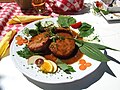 Saumagen

