Wuhan: Difference between revisions
CSV import |
CSV import |
||
| Line 30: | Line 30: | ||
{{geography-stub}} | {{geography-stub}} | ||
<gallery> | |||
File:武汉黄鹤楼俯瞰.jpg|Wuhan | |||
File:Yellow Crane Tower, 2013 photo.jpg|Yellow Crane Tower | |||
File:Optics Valley Square 2021.jpg|Optics Valley Square | |||
File:行政楼 20240321.jpg|Wuhan | |||
File:WuchangUprising.jpg|Wuchang Uprising | |||
File:Hankou Railway Station 2016.jpg|Hankou Railway Station | |||
File:Erligang map.svg|Erligang Map | |||
File:武汉黄鹤楼.jpg|Wuhan | |||
File:Wuhan 1864.jpg|Wuhan 1864 | |||
File:Hankow Bund c. 1900.jpg|Hankow Bund c. 1900 | |||
File:辛亥革命武昌蜂起記念館.jpg|Wuchang Uprising Memorial | |||
File:Hankow 1915.jpg|Hankow 1915 | |||
</gallery> | |||
Latest revision as of 01:43, 20 February 2025


Wuhan is the capital city of Hubei Province in the People's Republic of China. With a population of over 11 million people, it is the most populous city in Central China and one of the nine National Central Cities of China. Wuhan is recognized for its significant role in domestic transportation, as it serves as a major transportation hub, with dozens of railways, roads, and expressways passing through the city and connecting it to other major cities in China.
History[edit]
Wuhan's history dates back 3,500 years. It originated from the confluence of the Yangtze River and its largest tributary, the Han River. The city is historically comprised of three major towns: Wuchang, Hankou, and Hanyang, which merged in 1927 to form Wuhan. Throughout Chinese history, Wuhan has been a center of trade and commerce in central China. During the 1911 Revolution, Wuchang served as a focal point for revolutionary activities leading to the downfall of the Qing Dynasty and the establishment of the Republic of China.
Geography[edit]
Wuhan is located in the eastern Jianghan Plain, at the intersection of the middle reaches of the Yangtze and Han rivers. The city's metropolitan area is divided by these rivers into three districts: Wuchang, Hankou, and Hanyang, which are connected by several bridges. Wuhan's climate is humid subtropical, characterized by hot humid summers and cool to mild winters, with occasional cold snaps.
Economy[edit]
Wuhan is a major industrial and economic hub in China, with its economy focused on manufacturing, including automotive, steel production, and high-tech industries. The city is also home to multiple science parks and technology startups, contributing to its nickname "China's Silicon Valley." Additionally, Wuhan has a large service sector, with finance, education, and research playing significant roles in its economy.
Culture[edit]
Wuhan is known for its rich cultural heritage, including the Yellow Crane Tower, a historic structure that has inspired generations of poets and artists. The city is also home to the Hubei Provincial Museum, which houses a vast collection of artifacts that tell the story of China's ancient Chu culture. Wuhan's cuisine is notable for its hot and spicy dishes, including the famous hot dry noodles (Re Gan Mian).
Education[edit]
Wuhan is a center for education and research in central China, hosting numerous universities and colleges, including Wuhan University and Huazhong University of Science and Technology. These institutions are pivotal in the fields of science, technology, engineering, and mathematics (STEM) and contribute significantly to the city's research output and technological advancements.
Transportation[edit]
As a major transportation hub, Wuhan boasts an extensive network of roads, railways, and an international airport, Wuhan Tianhe International Airport, facilitating domestic and international travel. The city is also a key node on the Yangtze River, supporting a busy port for cargo and passenger transport.
Healthcare[edit]
Wuhan is equipped with a comprehensive healthcare system, including several large hospitals and research institutions focused on medical science. The city gained international attention in late 2019 as the epicenter of the COVID-19 outbreak, which led to significant efforts in medical research and healthcare response.
Challenges[edit]
Wuhan faces several urban challenges, including environmental pollution, traffic congestion, and the need for sustainable urban development. The city's government has been implementing measures to address these issues, focusing on green development and improving public transportation systems.

-
 Wuhan
Wuhan -
 Yellow Crane Tower
 -
 Optics Valley Square
 -
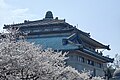 Wuhan
Wuhan -
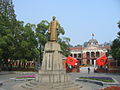 Wuchang Uprising
 -
 Hankou Railway Station
 -
 Erligang Map
 -
 Wuhan
Wuhan -
 Wuhan 1864
 -
 Hankow Bund c. 1900
 -
Wuchang Uprising Memorial
-
 Hankow 1915


