Birdshot chorioretinopathy: Difference between revisions
CSV import |
CSV import |
||
| Line 24: | Line 24: | ||
[[Category:Autoimmune diseases]] | [[Category:Autoimmune diseases]] | ||
{{Eye-disease-stub}} | {{Eye-disease-stub}} | ||
<gallery> | |||
File:Introductieslide.png|Birdshot chorioretinopathy | |||
</gallery> | |||
Revision as of 01:43, 20 February 2025
Birdshot chorioretinopathy is a rare form of inflammatory disease that affects the eye, specifically the retina and choroid. It is characterized by multiple cream or yellowish-white lesions scattered in a "birdshot" pattern. The disease is typically bilateral, affecting both eyes, and is more common in middle-aged individuals, particularly those of Caucasian descent.
Etiology
The exact cause of birdshot chorioretinopathy is unknown, but it is believed to be an autoimmune disease. Some studies have suggested a strong association with the human leukocyte antigen (HLA)-A29, a specific genetic marker. However, not all individuals with this marker develop the disease, indicating that other genetic or environmental factors may also play a role.
Symptoms
Symptoms of birdshot chorioretinopathy can vary widely among individuals. Common symptoms include blurred vision, floaters, night blindness, and loss of color vision. In some cases, the disease may also cause pain or redness in the eye. However, many individuals with birdshot chorioretinopathy do not experience any symptoms in the early stages of the disease.
Diagnosis
Diagnosis of birdshot chorioretinopathy is typically based on a combination of clinical findings and imaging studies. The characteristic "birdshot" pattern of lesions can often be seen on fundus photography or fluorescein angiography. In some cases, optical coherence tomography (OCT) may also be used to assess the extent of retinal damage.
Treatment
There is currently no cure for birdshot chorioretinopathy, and treatment is primarily aimed at managing symptoms and preventing further vision loss. This may involve the use of corticosteroids or other immunosuppressive drugs. Regular follow-up with an ophthalmologist is also important to monitor for potential complications, such as cataract or glaucoma.
Prognosis
The prognosis for individuals with birdshot chorioretinopathy can vary widely. Some individuals may experience only mild vision loss, while others may progress to severe vision loss or blindness. Early detection and treatment can help to slow the progression of the disease and improve quality of life.

-
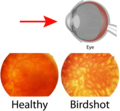 Birdshot chorioretinopathy

