Orthokeratology: Difference between revisions
No edit summary |
CSV import |
||
| Line 28: | Line 28: | ||
[[Category:Vision]] | [[Category:Vision]] | ||
[[Category:Ophthalmology]] | [[Category:Ophthalmology]] | ||
<gallery> | |||
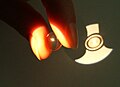
File:Ортокератологическая линза.JPG|Orthokeratology | |||
</gallery> | |||
Latest revision as of 01:30, 20 February 2025
A non-surgical procedure to temporarily reshape the cornea and improve vision
Orthokeratology, often abbreviated as ortho-k, is a non-surgical procedure that involves the use of specially designed rigid gas-permeable contact lenses to temporarily reshape the cornea to improve vision. This method is primarily used to correct myopia (nearsightedness), but it can also address other refractive errors such as hyperopia (farsightedness) and astigmatism.
Procedure[edit]
Orthokeratology involves the overnight wear of custom-fitted contact lenses that gently reshape the corneal surface. The lenses are removed in the morning, and the reshaping effect allows for clear vision throughout the day without the need for glasses or contact lenses. The effect is temporary, and the cornea gradually returns to its original shape if the lenses are not worn regularly.
Fitting Process[edit]
The fitting process for orthokeratology lenses involves a comprehensive eye examination and corneal topography to map the surface of the cornea. Based on these measurements, a custom lens is designed to fit the unique shape of the patient's eye. The fitting process may require several visits to fine-tune the lens design and ensure optimal vision correction and comfort.
Mechanism of Action[edit]
Orthokeratology lenses work by flattening the central cornea, which reduces its refractive power. This change in curvature allows light to focus more accurately on the retina, improving visual acuity. The lenses are made from highly oxygen-permeable materials to maintain corneal health during overnight wear.
Benefits and Limitations[edit]
Orthokeratology offers several benefits, including the elimination of daytime contact lens wear, which can be advantageous for individuals with active lifestyles or those who work in dusty environments. It is also a non-invasive alternative to laser eye surgery for vision correction.
However, orthokeratology is not suitable for everyone. The procedure requires a commitment to wearing the lenses regularly and maintaining proper lens hygiene. Additionally, the reshaping effect is temporary, and vision may fluctuate if the lenses are not worn consistently.
Safety and Side Effects[edit]
Orthokeratology is generally considered safe when performed under the supervision of a qualified eye care professional. Potential side effects include mild discomfort, glare, and halos around lights, particularly during the initial adaptation period. Serious complications are rare but can include corneal abrasion or infection if proper lens care is not followed.
Related pages[edit]
-
 Orthokeratology

