Shellfish: Difference between revisions
CSV import Tags: mobile edit mobile web edit |
CSV import |
||
| Line 57: | Line 57: | ||
{{medicine-stub}} | {{medicine-stub}} | ||
<gallery> | |||
File:Oysters p1040741.jpg|Oysters | |||
File:Cocktail 1 bg 060702.jpg|Cocktail | |||
File:Rheinische Muscheln.jpg|Rheinische Muscheln | |||
File:Sakura ebi.jpg|Sakura Ebi | |||
File:Boiled Maine Lobster.jpg|Boiled Maine Lobster | |||
File:Scallop sandwich (1).jpg|Scallop Sandwich | |||
File:Gambas in XXmiglia market.jpg|Gambas | |||
File:Cooked Snail Found In Rajang River.jpg|Cooked Snail | |||
</gallery> | |||
Latest revision as of 01:10, 20 February 2025


Shellfish are aquatic animals that have a shell or shell-like exoskeleton. They are divided into two main categories: crustaceans and mollusks. Shellfish are a significant source of protein and are consumed worldwide. They are also important in various ecosystems and have economic importance in the fishing industry.
Types of Shellfish[edit]
Shellfish can be broadly categorized into two groups:
Crustaceans[edit]
Crustaceans are a large, diverse group of arthropods that include species such as:
These animals typically have a hard exoskeleton and jointed limbs. They are found in various aquatic environments, from freshwater to marine habitats.
Mollusks[edit]
Mollusks are a diverse group of invertebrates that include:
Mollusks have a soft body, which in many species is protected by a hard shell. They are found in both marine and freshwater environments.
Nutritional Value[edit]
Shellfish are rich in protein, omega-3 fatty acids, and various vitamins and minerals. They are low in fat and calories, making them a healthy dietary choice. However, some people may be allergic to shellfish, which can cause severe reactions.
Economic Importance[edit]
Shellfish are a crucial part of the fishing industry and contribute significantly to the economy of many coastal regions. They are harvested both from the wild and through aquaculture. The demand for shellfish has led to advancements in sustainable fishing practices and aquaculture techniques.
Environmental Impact[edit]
The harvesting of shellfish can have both positive and negative impacts on the environment. Sustainable practices help maintain biodiversity and the health of aquatic ecosystems. However, overfishing and habitat destruction can lead to environmental degradation.
Health Concerns[edit]
While shellfish are nutritious, they can also pose health risks. Shellfish can accumulate toxins from their environment, such as heavy metals and biotoxins. Proper handling, storage, and cooking are essential to minimize these risks.
See Also[edit]
References[edit]
<references group="" responsive="1"></references>
External Links[edit]


-
 Oysters
 -
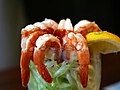 Cocktail
 -
 Rheinische Muscheln
 -
 Sakura Ebi
 -
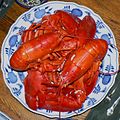 Boiled Maine Lobster
 -
 Scallop Sandwich
 -
 Gambas
 -
 Cooked Snail
.jpg)


