Very long-chain acyl-coenzyme A dehydrogenase deficiency: Difference between revisions
No edit summary |
CSV import |
||
| Line 68: | Line 68: | ||
[[Category:Fatty-acid metabolism disorders]] | [[Category:Fatty-acid metabolism disorders]] | ||
[[Category:Rare diseases]] | [[Category:Rare diseases]] | ||
<gallery> | |||
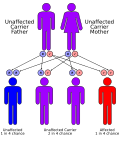
File:autorecessive.svg|Very long-chain acyl-coenzyme A dehydrogenase deficiency | |||
</gallery> | |||
Revision as of 00:40, 20 February 2025
| Very long-chain acyl-coenzyme A dehydrogenase deficiency | |
|---|---|

| |
| Synonyms | VLCADD |
| Pronounce | |
| Field | |
| Symptoms | |
| Complications | |
| Onset | |
| Duration | |
| Types | |
| Causes | |
| Risks | |
| Diagnosis | |
| Differential diagnosis | |
| Prevention | |
| Treatment | |
| Medication | |
| Prognosis | |
| Frequency | |
| Deaths | |
Very long-chain acyl-coenzyme A dehydrogenase deficiency is a fatty-acid metabolism disorder which prevents the body from converting certain fats to energy, particularly during periods without food.<ref>Nancy D.,
 GeneReviews,

 Seattle (WA):University of Washington, Seattle,update 2014</ref><ref>
Reference, Genetics Home. VLCAD deficiency(link). Genetics Home Reference.
Accessed 2017-02-27.
</ref><ref>
VLCAD deficiency | Genetic and Rare Diseases Information Center (GARD) – an NCATS Program(link). rarediseases.info.nih.gov.
Accessed 2018-04-17.
</ref>
Those affected by this disorder have inadequate levels of an enzyme that breaks down a group of fats called very long-chain fatty acids. (February 2017) <ref> Reference, Genetics Home. VLCAD deficiency(link). Genetics Home Reference.
Accessed 2018-04-17.
</ref>
Signs/symptoms
Signs and symptoms can include:<ref>
Very Long Chain Acyl CoA Dehydrogenase Deficiency (LCAD)(link). {{{website}}}.
</ref>
- hypoglycemia
- lethargy
- hepatomegaly
- muscle pain
- cardiomyopathy
Genetics
Mutations in the ACADVL gene lead to inadequate levels of an enzyme called very long-chain acyl-coenzyme A (CoA) dehydrogenase. Without this enzyme, very long-chain fatty acids from food and fats stored in the body cannot be degraded and processed. As a result, these fatty acids are not converted into energy, which can lead to characteristic signs and symptoms of this disorder, such as lethargy and hypoglycemia. Levels of very long-chain fatty acids or partially degraded fatty acids may build up in tissues and can damage the heart, liver, and muscles, causing more serious complications.
Diagnosis
Typically, initial signs and symptoms of this disorder occur during infancy and include low blood sugar (hypoglycemia), lack of energy (lethargy), and muscle weakness. There is also a high risk of complications such as liver abnormalities and life-threatening heart problems. Symptoms that begin later in childhood, adolescence, or adulthood tend to be milder and usually do not involve heart problems. Episodes of very long-chain acyl-coenzyme A dehydrogenase deficiency can be triggered by periods of fasting, illness, and exercise.
It is common for babies and children with the early and childhood types of VLCADD to have episodes of illness called metabolic crises. Some of the first symptoms of a metabolic crisis are: extreme sleepiness, behavior changes, irritable mood, poor appetite. Some of these other symptoms of VLCADD in infants may also follow: fever, nausea, diarrhea, vomiting, hypoglycemia.
Treatment
If a metabolic crisis is not treated, a child with VLCADD can develop: breathing problems, seizures, coma, sometimes leading to death.
References
External links
| Inborn error of lipid metabolism: fatty-acid metabolism disorders | ||||||||||||||||||||||||
|---|---|---|---|---|---|---|---|---|---|---|---|---|---|---|---|---|---|---|---|---|---|---|---|---|
|
-
 Very long-chain acyl-coenzyme A dehydrogenase deficiency
