Fragaria: Difference between revisions
CSV import |
CSV import |
||
| Line 40: | Line 40: | ||
File:Sosnovka_Bekovo_2014_Wild_Strawberries.jpg|Wild Strawberries | File:Sosnovka_Bekovo_2014_Wild_Strawberries.jpg|Wild Strawberries | ||
File:Fragaria_viridis_fruit_-_Keila.jpg|Fragaria viridis fruit | File:Fragaria_viridis_fruit_-_Keila.jpg|Fragaria viridis fruit | ||
</gallery> | |||
<gallery> | |||
File:103_Fragaria_vesca_L.jpg|Fragaria | |||
</gallery> | </gallery> | ||
Revision as of 00:33, 20 February 2025
Fragaria is a genus of flowering plants in the rose family, Rosaceae, commonly known as strawberries for their edible fruits. The genus is widespread across the temperate regions of the world, with a few species extending into the subtropical regions. Fragaria species are herbaceous perennials with a rhizomatous growth form. The leaves are typically trifoliate, with a toothed margin, and are borne on slender stalks. The flowers, which are white, usually appear in spring and are followed by the red, fleshy fruit.
Description
Fragaria plants are characterized by their trifoliate leaves, with three leaflets per leaf, and their white flowers, which consist of five petals. The fruit of Fragaria species, commonly referred to as a strawberry, is an aggregate accessory fruit; it is not a true berry. The fleshy and edible part of the fruit is actually a swollen receptacle, with the true fruits, or achenes, embedded in its surface.
Taxonomy
The genus Fragaria was first described by Carl Linnaeus in 1753. It belongs to the family Rosaceae, subfamily Rosoideae, and is closely related to other economically important genera such as Rosa (roses) and Rubus (blackberries and raspberries).
Species
There are more than 20 recognized species of Fragaria, including:
- Fragaria vesca (wild strawberry)
- Fragaria virginiana (Virginia strawberry)
- Fragaria chiloensis (beach strawberry)
- Fragaria × ananassa (garden strawberry), which is a hybrid species created from Fragaria virginiana and Fragaria chiloensis, and is the most widely cultivated strawberry species.
Cultivation
Strawberries are cultivated worldwide for their fruit. The cultivation process varies depending on the species and the intended use of the fruit, whether for fresh consumption or processing. Garden strawberries (Fragaria × ananassa) are the most widely grown species due to their large, sweet fruits. They require well-drained, rich soils, and a sunny location. Strawberries are susceptible to a variety of pests and diseases, which can be managed through integrated pest management practices.
Uses
Strawberries are consumed fresh, and are also processed into a variety of products, including jams, jellies, and syrups. They are rich in vitamin C, manganese, and several other vitamins and minerals. In addition to their culinary uses, strawberries are also used in cosmetics and as natural dyes.
Conservation
Some wild Fragaria species are considered rare or endangered in their natural habitats due to habitat loss, pollution, and overharvesting. Conservation efforts are underway in various parts of the world to preserve these species.
See also
.jpg)
-
 Fragaria vesca
 -
 Fragaria daltoniana
 -
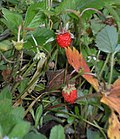 Fragaria vesca
 -
 Fragaria nilgerrensis
 -
 Wild Strawberries
 -
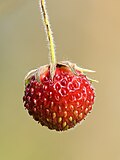 Fragaria viridis fruit


-
Fragaria
