Fragaria virginiana
Fragaria virginiana, also known as the wild strawberry, Virginia strawberry, or common strawberry, is a North American species of strawberry in the rose family. It is one of two species of wild strawberry that were hybridized to create the modern domesticated garden strawberry.
Description[edit]
Fragaria virginiana is a perennial plant that grows to a height of 5–20 cm (2–8 in). The leaves are trifoliate with a petiole up to 15 cm (6 in) long, each leaflet is 2–5 cm (0.8–2.0 in) broad, with a serrated margin. The flowers are produced in clusters on slender stalks arising from the leaf axils, each flower about 1 cm (0.4 in) diameter with five white petals, ten stamens, and a knobby, roundish pistil. The fruit, which is produced in June and July, is edible and is widely used in jams, jellies, pies, and other desserts.
Distribution and habitat[edit]
Fragaria virginiana is native to eastern North America, from Quebec and Newfoundland west to Saskatchewan, and south to Alabama and Texas. It is also found in western North America, from Alaska to California. It grows in a variety of habitats, including forests, open fields, and disturbed areas.
Cultivation and uses[edit]
The fruit of Fragaria virginiana was consumed by Native Americans, who also used the leaves and roots medicinally. The plant is cultivated for its fruit, and is also used as a ground cover. It is resistant to a number of diseases that affect the cultivated strawberry, and has been used in breeding programs to improve disease resistance in the cultivated species.
See also[edit]
.jpg) | This Rosaceae article is a stub. You can help WikiMD by expanding the page. |

This North American flora related article is a stub. You can help WikiMD by expanding it.
-
 Fragaria virginiana plant with leaves and flowers
 -
 Close-up of Fragaria virginiana fruit
 -
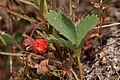 Fragaria virginiana in its natural habitat


Medical Disclaimer: WikiMD is for informational purposes only and is not a substitute for professional medical advice. Content may be inaccurate or outdated and should not be used for diagnosis or treatment. Always consult your healthcare provider for medical decisions. Verify information with trusted sources such as CDC.gov and NIH.gov. By using this site, you agree that WikiMD is not liable for any outcomes related to its content. See full disclaimer.
Credits:Most images are courtesy of Wikimedia commons, and templates, categories Wikipedia, licensed under CC BY SA or similar.
Translate this page: - East Asian
中文,
日本,
한국어,
South Asian
हिन्दी,
தமிழ்,
తెలుగు,
Urdu,
ಕನ್ನಡ,
Southeast Asian
Indonesian,
Vietnamese,
Thai,
မြန်မာဘာသာ,
বাংলা
European
español,
Deutsch,
français,
Greek,
português do Brasil,
polski,
română,
русский,
Nederlands,
norsk,
svenska,
suomi,
Italian
Middle Eastern & African
عربى,
Turkish,
Persian,
Hebrew,
Afrikaans,
isiZulu,
Kiswahili,
Other
Bulgarian,
Hungarian,
Czech,
Swedish,
മലയാളം,
मराठी,
ਪੰਜਾਬੀ,
ગુજરાતી,
Portuguese,
Ukrainian
