Arable land: Difference between revisions
CSV import |
CSV import |
||
| Line 8: | Line 8: | ||
File:Beverley_Minster_from_West_Pasture.jpg|Arable land near Beverley Minster from West Pasture | File:Beverley_Minster_from_West_Pasture.jpg|Arable land near Beverley Minster from West Pasture | ||
</gallery> | </gallery> | ||
== Arable Land == | |||
'''Arable land''' refers to land capable of being ploughed and used to grow crops. It is a critical component of [[agriculture]] and plays a significant role in the [[food production]] systems worldwide. The availability and quality of arable land are essential for ensuring food security and supporting the livelihoods of millions of people. | |||
== Characteristics == | |||
Arable land is typically characterized by its [[soil fertility]], which is the ability of the soil to provide essential nutrients to plants. Factors that influence soil fertility include the presence of [[organic matter]], [[soil pH]], and the availability of [[water]]. Arable land is often flat or gently sloping, which facilitates [[mechanized farming]] and efficient [[irrigation]]. | |||
== Distribution == | |||
The distribution of arable land varies significantly across the globe. Regions with favorable climates, such as temperate zones, tend to have more arable land. Countries like [[India]], [[China]], and the [[United States]] have large areas of arable land, supporting their substantial agricultural outputs. In contrast, arid and semi-arid regions, such as parts of [[Africa]] and the [[Middle East]], have limited arable land due to harsh climatic conditions. | |||
== Uses == | |||
Arable land is primarily used for growing [[cereal crops]] such as [[wheat]], [[rice]], and [[maize]], which are staple foods for a large portion of the world's population. It is also used for cultivating [[vegetables]], [[fruits]], and [[legumes]]. The choice of crops depends on factors such as climate, soil type, and market demand. | |||
== Challenges == | |||
Several challenges threaten the availability and productivity of arable land. These include: | |||
* [[Soil erosion]]: The removal of topsoil by wind and water can reduce soil fertility and lead to land degradation. | |||
* [[Desertification]]: The process by which fertile land becomes desert, typically as a result of drought, deforestation, or inappropriate agriculture. | |||
* [[Urbanization]]: The expansion of urban areas often encroaches on arable land, reducing the area available for agriculture. | |||
* [[Climate change]]: Changes in temperature and precipitation patterns can affect the suitability of land for agriculture. | |||
== Conservation == | |||
Efforts to conserve arable land focus on sustainable agricultural practices, such as: | |||
* [[Crop rotation]]: Growing different types of crops in succession on the same land to maintain soil fertility and reduce pest and disease buildup. | |||
* [[Conservation tillage]]: Reducing the frequency and intensity of tillage to minimize soil disturbance and erosion. | |||
* [[Agroforestry]]: Integrating trees and shrubs into agricultural landscapes to enhance biodiversity and improve soil health. | |||
== Related Pages == | |||
* [[Agriculture]] | |||
* [[Soil fertility]] | |||
* [[Irrigation]] | |||
* [[Sustainable agriculture]] | |||
{{Agriculture}} | |||
[[Category:Agriculture]] | |||
[[Category:Land use]] | |||
Latest revision as of 00:37, 19 February 2025
Arable_land[edit]
-
 Arable land in Dorset, Marnhull
 -
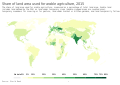 Share of land area used for arable agriculture
 -
 Arable land in Chvojnica hills near Unin
 -
 Arable land near Iglesia de Nuestra Señora de La Blanca, Cardejón, España
 -
 Arable land with Kerbau Jawa
 -
 Arable land near Beverley Minster from West Pasture


Arable Land[edit]
Arable land refers to land capable of being ploughed and used to grow crops. It is a critical component of agriculture and plays a significant role in the food production systems worldwide. The availability and quality of arable land are essential for ensuring food security and supporting the livelihoods of millions of people.
Characteristics[edit]
Arable land is typically characterized by its soil fertility, which is the ability of the soil to provide essential nutrients to plants. Factors that influence soil fertility include the presence of organic matter, soil pH, and the availability of water. Arable land is often flat or gently sloping, which facilitates mechanized farming and efficient irrigation.
Distribution[edit]
The distribution of arable land varies significantly across the globe. Regions with favorable climates, such as temperate zones, tend to have more arable land. Countries like India, China, and the United States have large areas of arable land, supporting their substantial agricultural outputs. In contrast, arid and semi-arid regions, such as parts of Africa and the Middle East, have limited arable land due to harsh climatic conditions.
Uses[edit]
Arable land is primarily used for growing cereal crops such as wheat, rice, and maize, which are staple foods for a large portion of the world's population. It is also used for cultivating vegetables, fruits, and legumes. The choice of crops depends on factors such as climate, soil type, and market demand.
Challenges[edit]
Several challenges threaten the availability and productivity of arable land. These include:
- Soil erosion: The removal of topsoil by wind and water can reduce soil fertility and lead to land degradation.
- Desertification: The process by which fertile land becomes desert, typically as a result of drought, deforestation, or inappropriate agriculture.
- Urbanization: The expansion of urban areas often encroaches on arable land, reducing the area available for agriculture.
- Climate change: Changes in temperature and precipitation patterns can affect the suitability of land for agriculture.
Conservation[edit]
Efforts to conserve arable land focus on sustainable agricultural practices, such as:
- Crop rotation: Growing different types of crops in succession on the same land to maintain soil fertility and reduce pest and disease buildup.
- Conservation tillage: Reducing the frequency and intensity of tillage to minimize soil disturbance and erosion.
- Agroforestry: Integrating trees and shrubs into agricultural landscapes to enhance biodiversity and improve soil health.
Related Pages[edit]
| Agriculture |
|---|
|
[[File:
 |200px|center|alt=]] |200px|center|alt=]]
|
