Oomycete: Difference between revisions
CSV import |
CSV import |
||
| Line 38: | Line 38: | ||
{{micro-stub}} | {{micro-stub}} | ||
{{plant-path-stub}} | {{plant-path-stub}} | ||
<gallery> | |||
File:Phytophtora_reproduction.png|Oomycete | |||
File:2023_Oomycete.svg|Oomycete | |||
File:07_01_filogenia,_simplificada,_Oomycota_(M._Piepenbring).png|Oomycete | |||
File:07_07_asexual_structures,_Saprolegniales,_Albuginales,_Peronosporales,_Oomycota_(M._Piepenbring).png|Oomycete | |||
File:Oomy1002L.jpg|Oomycete | |||
File:Pythium_(257_23).jpg|Oomycete | |||
File:Late_blight_on_potato_leaf_2.jpg|Oomycete | |||
File:Albugo_candida.jpg|Oomycete | |||
File:07_08_life_cycle,_Phytophthora_infestans_on_potato,_Peronosporales,_Oomycota_(M._Piepenbring).png|Oomycete | |||
File:Water_mold.JPG|Oomycete | |||
File:Water_mold_Mizukabi_colony.jpg|Oomycete | |||
File:Seatrout_UDN_saprolegnia.jpg|Oomycete | |||
</gallery> | |||
Latest revision as of 12:25, 18 February 2025
Oomycete is a class of microorganisms that are similar to fungi in their growth habits and infection mechanisms, but are more closely related to algae. They are often referred to as "water molds" due to their preference for water-rich environments. Oomycetes are responsible for a number of serious plant diseases, including late blight of potatoes and downy mildew of grapes.
Classification[edit]
Oomycetes belong to the kingdom Stramenopila, which also includes diatoms and brown algae. They are classified in the class Oomycota, which is divided into several orders, including Peronosporales, Saprolegniales, and Pythiales. These orders are distinguished by differences in their life cycles and the structures they produce.
Morphology[edit]
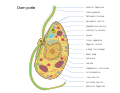
Oomycetes are characterized by the production of hyphae, which are thread-like structures that absorb nutrients from the environment. They also produce sporangia, which are structures that produce and release spores. The spores of oomycetes are unique in that they have two flagella, one of which is covered in hair-like projections.
Life Cycle[edit]
The life cycle of oomycetes involves both asexual and sexual reproduction. Asexual reproduction occurs through the production of spores in the sporangia. These spores can swim in water to find new hosts. Sexual reproduction involves the fusion of male and female gametes, which produces a thick-walled oospore that can survive in harsh conditions.
Pathogenicity[edit]
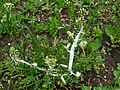
Many oomycetes are pathogens, causing diseases in a wide range of plants. They infect their hosts by producing enzymes that break down the plant cell walls, allowing the hyphae to penetrate the tissues. Once inside, they absorb nutrients from the plant cells, causing disease symptoms such as wilting, yellowing, and death.
Control[edit]
Control of oomycete diseases involves a combination of cultural practices, such as crop rotation and sanitation, and the use of fungicides. However, many oomycetes are becoming resistant to these chemicals, making control increasingly difficult.
Economic Importance[edit]
Oomycetes have a significant economic impact due to the damage they cause to crops. The most famous example is the Irish Potato Famine, which was caused by the oomycete Phytophthora infestans and led to the death of a million people in Ireland in the mid-19th century.
See Also[edit]
This plant-pathology-related article is a stub. You can help WikiMD by expanding it.
-
 Oomycete
 -
 Oomycete
 -
 Oomycete
 -
 Oomycete
 -
 Oomycete
 -
 Oomycete
 -
 Oomycete
 -
 Oomycete
 -
 Oomycete
 -
 Oomycete
 -
 Oomycete
 -
 Oomycete


.png)
.png)

.jpg)


.png)


