Straight dough: Difference between revisions
CSV import |
CSV import |
||
| Line 16: | Line 16: | ||
[[Category:Bread]] | [[Category:Bread]] | ||
{{food-stub}} | {{food-stub}} | ||
<gallery> | |||
File:Mixing_Tara's_Fried_Dough.jpg|Straight_dough | |||
File:Waga_elektroniczna.jpg|Straight_dough | |||
File:Breaddough1.jpg|Straight_dough | |||
File:Breaddough2.jpg|Straight_dough | |||
File:US_Navy_071030-N-0167B-058_Culinary_Specialist_Seaman_Brandon_Freeman,_of_Lakeland,_Fla.,_kneads_dough_into_rolls_in_USS_Kitty_Hawk's_bake_shop.jpg|Straight_dough | |||
File:Bread_dough_in_tin.jpg|Straight_dough | |||
File:Risen_bread_dough_in_tin.jpg|Straight_dough | |||
File:Einstechthermometer.jpg|Straight_dough | |||
</gallery> | |||
Revision as of 12:24, 18 February 2025
Straight Dough is a method used in baking to make bread. It is one of the simplest methods of bread production, often used by home bakers and in some commercial bakeries.
Overview
The straight dough method involves mixing all ingredients together at once. This is in contrast to other methods such as the sponge and dough method or the pre-ferment method, which involve multiple stages of mixing and fermenting. The straight dough method is often chosen for its simplicity and speed, as it requires less time and fewer steps than other methods.
Process
The process of making bread using the straight dough method involves several steps. First, the flour, yeast, water, and other ingredients are mixed together to form a dough. The dough is then kneaded until it becomes smooth and elastic. After kneading, the dough is left to rise, or proof, until it has doubled in size. Once the dough has risen, it is shaped into loaves and left to rise again. Finally, the loaves are baked in an oven until they are golden brown and fully cooked.
Advantages and Disadvantages
The main advantage of the straight dough method is its simplicity. It requires fewer steps and less time than other methods, making it a good choice for beginner bakers or for those who want to make bread quickly. However, bread made using the straight dough method may not have as complex a flavor or as fine a texture as bread made using other methods. This is because the straight dough method does not involve a long fermentation period, which can help to develop flavor and texture in the bread.
Variations
While the basic process of the straight dough method is always the same, there are many variations that can be used to alter the flavor and texture of the bread. For example, different types of flour can be used, such as whole wheat flour or rye flour. Other ingredients, such as sugar, salt, butter, and milk, can also be added to the dough to enhance its flavor and texture.

-
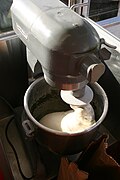 Straight_dough
 -
 Straight_dough
 -
 Straight_dough
 -
 Straight_dough
 -
 Straight_dough
 -
 Straight_dough
 -
 Straight_dough
 -
 Straight_dough


