Arisaema triphyllum: Difference between revisions
CSV import |
CSV import |
||
| Line 31: | Line 31: | ||
[[Category:Developmental biology]] | [[Category:Developmental biology]] | ||
[[Category:Embryology]] | [[Category:Embryology]] | ||
== Arisaema triphyllum == | |||
<gallery> | |||
File:Arisaema_triphyllum_Bob_Hunter_Memorial_Park.jpg|Arisaema triphyllum in Bob Hunter Memorial Park | |||
File:Jack_in_the_pupit.jpg|Jack in the Pulpit | |||
File:Jack-in-the-Pulpit.jpg|Jack-in-the-Pulpit | |||
File:Arisaema_triphyllum_(Jack_in_the_Pulpit).jpg|Arisaema triphyllum (Jack in the Pulpit) | |||
File:Jack-in-the-pulpit.JPG|Jack-in-the-pulpit | |||
File:Seeds_Arisaema_triphyllum_-_Jack-in-pulpit.jpg|Seeds of Arisaema triphyllum - Jack-in-pulpit | |||
File:JitPseeds.JPG|Seeds of Jack-in-the-Pulpit | |||
File:Arisaema_triphyllum_seeds_with_pulp_strainer.jpg|Arisaema triphyllum seeds with pulp strainer | |||
File:Phronia_female.jpg|Phronia female | |||
</gallery> | |||
Revision as of 12:24, 18 February 2025
Structure in developing limb buds of vertebrate embryos
Apical Ectodermal Ridge
The apical ectodermal ridge (AER) is a critical structure in the development of the limbs in vertebrate embryos. It is a thickened area of ectoderm at the distal end of the developing limb bud. The AER plays a crucial role in the proper formation of the limb by regulating the growth and patterning of the underlying mesenchyme.
Structure and Function
The AER is located at the tip of the limb bud and is composed of a specialized group of epithelial cells. These cells are responsible for maintaining the proliferation of the mesenchymal cells beneath them, which is essential for the elongation of the limb. The AER achieves this by secreting signaling molecules, such as fibroblast growth factors (FGFs), which are crucial for limb development.
The interaction between the AER and the underlying mesenchyme is a classic example of epithelial-mesenchymal interaction, which is a common theme in developmental biology. The AER ensures that the mesenchyme continues to proliferate and differentiate into the various tissues that will form the limb, including bone, muscle, and cartilage.
Developmental Role
The AER is essential for the proper patterning of the limb along the proximal-distal axis. It helps to establish the identity of different regions of the limb, such as the humerus, radius, and ulna in the forelimb, or the femur, tibia, and fibula in the hindlimb. The removal of the AER at different stages of development results in the truncation of the limb at different points, highlighting its role in limb outgrowth.
Molecular Signaling
The AER is a source of several important signaling molecules that regulate limb development. Among these, FGFs are the most well-studied. FGFs produced by the AER include FGF8, FGF4, and FGF9, which act on the underlying mesenchyme to promote cell proliferation and survival. These signals are part of a complex network of interactions that also involve other signaling pathways, such as the Sonic hedgehog (Shh) pathway, which is important for anterior-posterior patterning of the limb.
Clinical Significance
Defects in the formation or function of the AER can lead to congenital limb malformations. Conditions such as amelia (absence of limbs) or meromelia (partial absence of limbs) can result from disruptions in the signaling pathways associated with the AER. Understanding the molecular mechanisms governing AER function is therefore important for developing therapeutic strategies for these conditions.
Related Pages
Gallery
-
 Diagram of a developing limb bud showing the apical ectodermal ridge.

Arisaema triphyllum
-
 Arisaema triphyllum in Bob Hunter Memorial Park
 -
 Jack in the Pulpit
 -
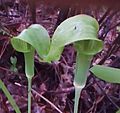 Jack-in-the-Pulpit
 -
 Arisaema triphyllum (Jack in the Pulpit)
 -
Jack-in-the-pulpit
-
Seeds of Arisaema triphyllum - Jack-in-pulpit
-
 Seeds of Jack-in-the-Pulpit
 -
 Arisaema triphyllum seeds with pulp strainer
 -
 Phronia female


.jpg)


