Space law: Difference between revisions
CSV import |
CSV import |
||
| Line 28: | Line 28: | ||
[[Category:Space exploration]] | [[Category:Space exploration]] | ||
{{law-stub}} | {{law-stub}} | ||
<gallery> | |||
File:Test_Ban_Treaty_(1963)_-_first_page.jpg|Test Ban Treaty (1963) - First Page | |||
File:Operation_Dominic_Starfish-Prime_nuclear_test_from_plane.jpg|Operation Dominic Starfish-Prime Nuclear Test from Plane | |||
File:Buzz_salutes_the_U.S._Flag.jpg|Buzz Salutes the U.S. Flag | |||
File:Comparison_satellite_navigation_orbits.svg|Comparison of Satellite Navigation Orbits | |||
File:North_pole_february_ice-pack_1978-2002.png|North Pole February Ice-Pack 1978-2002 | |||
File:Modelled_influence_of_a_decade_of_contemporary_rocket_launch_and_re-entry_heating_emissions_on_stratospheric_chemical_composition.jpg|Modelled Influence of a Decade of Contemporary Rocket Launch and Re-entry Heating Emissions on Stratospheric Chemical Composition | |||
File:2014_Space_Law_Business_Meeting_in_Washington,_DC_02_better_photo.JPG|2014 Space Law Business Meeting in Washington, DC | |||
</gallery> | |||
Latest revision as of 12:18, 18 February 2025
Space law is a branch of law that encompasses national and international law governing activities in outer space. International lawyers have been unable to agree on a uniform definition of the term "outer space", although most lawyers agree that outer space generally begins at the lowest altitude above sea level at which objects can orbit the Earth, approximately 100 kilometers (60 miles).
History[edit]
The inception of space law began with the launch of the world's first artificial satellite by the Soviet Union in October 1957. Sputnik 1, as it was called, launched the space age and the Space Race, a period of extreme competition between the United States and the Soviet Union to achieve firsts in spaceflight capability.
International space law[edit]
The United Nations has been pivotal in the development of international space law. The UN Office for Outer Space Affairs (UNOOSA) has since 1959 been responsible for promoting international cooperation in the peaceful uses of outer space. UNOOSA serves as the secretariat for the General Assembly's only committee dealing exclusively with international cooperation in the peaceful uses of outer space: the United Nations Committee on the Peaceful Uses of Outer Space (COPUOS).
National space law[edit]
National space law is the body of law governing space-related activities of individual nations. In contrast with international law, national law is more concerned with issues that are primarily of domestic concern. For example, the United States space law regulates activities of the United States government, U.S. companies and U.S. citizens.
Key principles[edit]
Space law covers several key principles including the exploration and use of outer space shall be carried out for the benefit and in the interests of all countries and shall be the province of all mankind; outer space shall be free for exploration and use by all States; outer space is not subject to national appropriation by claim of sovereignty, by means of use or occupation, or by any other means; States shall not place nuclear weapons or other weapons of mass destruction in orbit or on celestial bodies or station them in outer space in any other manner; the Moon and other celestial bodies shall be used exclusively for peaceful purposes; astronauts are the envoys of mankind; States shall be responsible for national space activities whether carried out by governmental or non-governmental entities; States shall be liable for damage caused by their space objects; and States shall avoid harmful contamination of space and celestial bodies.
See also[edit]
- Astronaut
- Space exploration
- Space Race
- United Nations Office for Outer Space Affairs
- United Nations Committee on the Peaceful Uses of Outer Space

-
 Test Ban Treaty (1963) - First Page
 -
 Operation Dominic Starfish-Prime Nuclear Test from Plane
 -
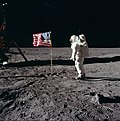 Buzz Salutes the U.S. Flag
 -
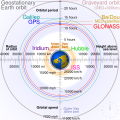 Comparison of Satellite Navigation Orbits
 -
 North Pole February Ice-Pack 1978-2002
 -
 Modelled Influence of a Decade of Contemporary Rocket Launch and Re-entry Heating Emissions on Stratospheric Chemical Composition
 -
 2014 Space Law Business Meeting in Washington, DC
_-_first_page.jpg)


