Outer space
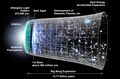
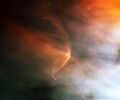
Outer space is the expanse that exists beyond the Earth and between celestial bodies. Outer space is not completely empty—it is a hard vacuum containing a low density of particles, predominantly a plasma of hydrogen and helium, as well as electromagnetic radiation, magnetic fields, neutrinos, dust, and cosmic rays. The baseline temperature of outer space, as set by the background radiation from the Big Bang, is 2.7 kelvins (−270.45 °C; −454.81 °F). The plasma between galaxies accounts for about half of the baryonic (ordinary) matter in the universe; it has a number density of less than one hydrogen atom per cubic metre and a temperature in the range of 10 million to 100 million kelvins. Local concentrations have condensed into galaxies and galactic clusters.
Overview[edit]
Outer space is the closest known approximation to a perfect vacuum. It has effectively no friction, allowing stars, planets, and moons to move freely along their ideal orbits, following the initial formation stage. However, even the deep vacuum of intergalactic space is not devoid of matter, as it contains a few hydrogen atoms per cubic meter. By comparison, the air humans breathe contains about 10^25 molecules per cubic meter. The low density of matter in outer space means that electromagnetic radiation can travel great distances without being scattered: the mean free path of a photon in intergalactic space is about 10^23 km, or 10 billion light years.
Physical properties[edit]
Outer space has very low density and pressure, and is the closest physical approximation of a perfect vacuum. But no vacuum is truly perfect, not even in interstellar space, where there are still a few hydrogen atoms per cubic meter.
Discovery and exploration[edit]
The concept of outer space was first theorized by British philosopher William Gilbert in the 17th century. It was later confirmed by Sir Isaac Newton's laws of motion and universal gravitation.
Legal status[edit]
The Outer Space Treaty, signed in 1967, states that space is free for all nations to explore, and is not subject to claims of national sovereignty.
See also[edit]
References[edit]

This WikiMD article can only be edited by registered and verified editors. You can log in or register.
-
Outer space
-
 Outer space
 -
Outer space
-
 Outer space
 -
 Outer space
 -
Outer space
-
 Outer space
 -
Outer space
-
Outer space
-
Outer space
-
 Outer space
 -
Outer space


Advertise on WikiMD — 81,000+ full articles, ~900,000 total pages, ~250 million page views. Global reach, limited time promotional rates from $1/page/day. Learn more · View stats


Translate page: - East Asian
中文,
日本,
한국어,
South Asian
हिन्दी,
தமிழ்,
తెలుగు,
Urdu,
ಕನ್ನಡ,
Southeast Asian
Indonesian,
Vietnamese,
Thai,
မြန်မာဘာသာ,
বাংলা
European
español,
Deutsch,
français,
Greek,
português do Brasil,
polski,
română,
русский,
Nederlands,
norsk,
svenska,
suomi,
Italian
Middle Eastern & African
عربى,
Turkish,
Persian,
Hebrew,
Afrikaans,
isiZulu,
Kiswahili,
Other
Bulgarian,
Hungarian,
Czech,
Swedish,
മലയാളം,
मराठी,
ਪੰਜਾਬੀ,
ગુજરાતી,
Portuguese,
Ukrainian
About WikiMD • Contact • Disclaimer • Privacy • Copyright • Site statistics
Some content and images may originate from Wikimedia Commons or Wikipedia and remain subject to their stated licenses. Unless otherwise noted, eligible WikiMD content is available under CC BY-SA 4.0.
WikiMD Wellnesspedia — Free health & wellness information for patients, students, and health professionals.


.jpg)


