John Dewey: Difference between revisions
CSV import |
CSV import Tags: mobile edit mobile web edit |
||
| Line 37: | Line 37: | ||
{{psychology-bio-stub}} | {{psychology-bio-stub}} | ||
{{edu-stub}} | {{edu-stub}} | ||
<gallery> | |||
File:John_Dewey_cph.3a51565.jpg|John Dewey | |||
File:John_Dewey_in_1902.jpg|John Dewey in 1902 | |||
File:Hu_Shih_and_John_Dewey.jpg|Hu Shih and John Dewey | |||
File:张謇与杜威等人的合影.jpg|John Dewey | |||
File:The_School_and_Society_-_Cover.jpg|The School and Society - Cover | |||
File:81il826HWlL-1581x2048.jpg|John Dewey | |||
File:The_Public_and_its_Problems,_1927,_Cover.jpg|The Public and its Problems, 1927, Cover | |||
File:John_Dewey_caricat.jpg|John Dewey | |||
File:John_Dewey_and_Nuri_Ja'far_-_1949.jpg|John Dewey and Nuri Ja'far - 1949 | |||
File:John_Dewey,_sem_data.tif|John Dewey | |||
File:John_Dewey_Grave.JPG|John Dewey Grave | |||
File:00JohnDewey.jpg|John Dewey | |||
</gallery> | |||
Latest revision as of 12:16, 18 February 2025
John Dewey (October 20, 1859 – June 1, 1952) was an American philosopher, psychologist, and educational reformer whose ideas have been influential in education and social reform. He is regarded as one of the most prominent American scholars in the first half of the twentieth century.
Early life and education[edit]
Dewey was born in Burlington, Vermont to a family of modest means. He was one of four boys born to Archibald Sprague Dewey and Lucina Artemisia Rich Dewey. He obtained his early education in a public school and in the University of Vermont, where he graduated in 1879.
Career[edit]
After his graduation, Dewey taught high school and later joined the University of Michigan, where he held the chair of philosophy. In 1894, Dewey joined the newly founded University of Chicago where he developed his belief in an empirically based theory of knowledge, becoming associated with the newly emerging Pragmatic philosophy. His time at the University of Chicago resulted in four essays collectively entitled Thought and its Subject-Matter, which was published with collected works from his colleagues at Chicago under the collective title Studies in Logical Theory (1903).
Philosophy and works[edit]
Dewey's most significant writings were "The Reflex Arc Concept in Psychology" (1896), a critique of a standard psychological concept and the basis of all his further work; Democracy and Education (1916), his celebrated work on progressive education; Human Nature and Conduct (1922), a study of the function of habit in human behavior; The Public and its Problems (1927), a defense of democracy written in response to Walter Lippmann's The Phantom Public (1925); and Experience and Nature (1925), Dewey's most "metaphysical" statement.
Among his many other works are Experience and Education (1938); A Common Faith (1934); Logic: The Theory of Inquiry (1938); Freedom and Culture (1939); Knowing and the Known (1949), a book written in conjunction with Arthur F. Bentley; and his later works on philosophy of law and on ethics.
Legacy[edit]
Dewey's influence began to decline in the late 1940s and the 1950s as neoorthodoxy in theology and existentialism in philosophy arose in popularity. However, his ideas about education and democracy were highly influential, shaping the progressive education movement in the 20th century.
See also[edit]
References[edit]
<references />
External links[edit]
This article is a Philosophy-related stub. You can help WikiMD by expanding it!
This article is a psychology stub. You can help WikiMD by expanding it!
-
 John Dewey
 -
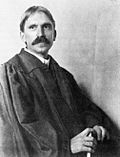 John Dewey in 1902
 -
 Hu Shih and John Dewey
 -
 John Dewey
 -
 The School and Society - Cover
 -
 John Dewey
 -
 The Public and its Problems, 1927, Cover
 -
 John Dewey
 -
 John Dewey and Nuri Ja'far - 1949
 -
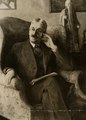 John Dewey
 -
John Dewey Grave
-
John Dewey


