God: Difference between revisions
CSV import |
CSV import Tags: mobile edit mobile web edit |
||
| Line 29: | Line 29: | ||
{{stub}} | {{stub}} | ||
<gallery> | |||
File:Mesha_Stele_(511142469)_(cropped).jpg|God | |||
File:St-thomas-aquinasFXD.jpg|God | |||
File:Système_de_la_Nature.jpg|God | |||
File:Shield-Trinity-Scutum-Fidei-English.svg|God | |||
File:Blake_God_Blessing.jpg|God | |||
File:Duerer-Prayer.jpg|God | |||
File:Allah_Names_in_Chinese_Arabic_Script.jpg|God | |||
File:Naqsh_i_Rustam._Investiture_d'Ardashir_1.jpg|God | |||
File:Ascension,_sacramentaire_de_Drogon.jpg|God | |||
File:Istanbul_027_(6445021161).jpg|God | |||
</gallery> | |||
Latest revision as of 12:14, 18 February 2025
God is a term used in various contexts to refer to a supreme being, deity, or spirit. The concept of God varies widely among different religions and belief systems. In monotheistic religions, God is typically conceived of as a singular, all-powerful, all-knowing, and benevolent entity. In polytheistic religions, there are multiple gods, each with their own specific domains or responsibilities.
Concepts of God[edit]
The concept of God varies widely among different religions and belief systems. Some common attributes associated with God include omnipotence (all-powerful), omniscience (all-knowing), omnipresence (present everywhere), divine simplicity, and eternal and necessary existence.
Monotheism[edit]
In monotheism, God is conceived of as the supreme being, creator deity, and principal object of faith. Monotheistic religions include Christianity, Islam, Judaism, and others.
Polytheism[edit]
In polytheism, there are multiple gods, each with their own specific domains or responsibilities. Polytheistic religions include Hinduism, Ancient Greek religion, Ancient Roman religion, and others.
Theism, Deism, and Pantheism[edit]
Theism is the belief in the existence of a god or gods. Deism is the belief in a creator who does not intervene in the universe. Pantheism is the belief that the universe itself is divine.
Atheism and Agnosticism[edit]
Atheism is the absence of belief in the existence of gods. Agnosticism is the view that the existence of God, or the divine, is unknown or unknowable.
Arguments for and against the existence of God[edit]
There are many philosophical and theological arguments for and against the existence of God. These include the cosmological argument, the ontological argument, the problem of evil, and others.
See also[edit]
 |
 |
-
God
-
God
-
God
-
God
-
God
-
God
-
 God
God -
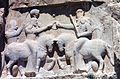 God
God -
 God
God -
 God
God


.jpg)


_(cropped).jpg)


