Atmosphere of Earth: Difference between revisions
CSV import |
CSV import |
||
| Line 37: | Line 37: | ||
{{Climate-stub}} | {{Climate-stub}} | ||
{{Weather-stub}} | {{Weather-stub}} | ||
<gallery> | |||
File:Top_of_Atmosphere.jpg|Atmosphere of Earth | |||
File:Atmosphere_gas_proportions.svg|Atmosphere of Earth | |||
File:Msis_atmospheric_composition_by_height.svg|Atmosphere of Earth | |||
File:Earth's_atmosphere.svg|Atmosphere of Earth | |||
File:ISS-46_Soyuz_TMA-17M_reentry.jpg|Atmosphere of Earth | |||
File:ISS-47_Islands_In_The_Sky,_Indonesia.jpg|Atmosphere of Earth | |||
File:Atmospheric_Temperature_Trend.jpg|Atmosphere of Earth | |||
File:Atmosphere_model.png|Atmosphere of Earth | |||
File:Openstax_Astronomy_EM_spectrum_and_atmosphere.jpg|Atmosphere of Earth | |||
File:SB_DouglasPreserve_SunAtmosphericEffects_2017_3_cropped.jpg|Atmosphere of Earth | |||
File:AtmosphCirc2.svg|Atmosphere of Earth | |||
File:Sauerstoffgehalt-1000mj2.png|Atmosphere of Earth | |||
</gallery> | |||
Latest revision as of 12:10, 18 February 2025
Atmosphere of Earth is the layer of gases, commonly known as air, that surrounds the Earth and is retained by Earth's gravity. The atmosphere of Earth protects life on Earth by creating pressure allowing for liquid water to exist on the Earth's surface, absorbing ultraviolet solar radiation, warming the surface through heat retention (greenhouse effect), and reducing temperature extremes between day and night (the diurnal temperature variation).
Composition[edit]
The atmosphere of Earth is a mixture of nitrogen (about 78%), oxygen (about 21%), argon (about 0.9%), carbon dioxide (0.04%) and other gases in trace amounts. Water vapor also is a significant constituent of Earth's atmosphere, though it varies in concentration from 0% in the cold polar regions to almost 4% in the tropics.
Structure[edit]
The atmosphere of Earth can be divided into five main layers. These are, from nearest to farthest from the Earth's surface:
- The Troposphere
- The Stratosphere
- The Mesosphere
- The Thermosphere
- The Exosphere
Weather and Climate[edit]
The weather and climate of Earth are driven by the atmospheric conditions. Weather refers to short-term changes in atmospheric conditions, while climate refers to long-term patterns.
Importance to Life[edit]
The atmosphere of Earth is vital for life as it provides oxygen for humans and animals to breathe, carbon dioxide for plants to photosynthesize, and protects life from harmful levels of solar radiation and cosmic rays.
See Also[edit]
-
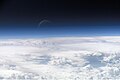 Atmosphere of Earth
 -
 Atmosphere of Earth
 -
 Atmosphere of Earth
 -
 Atmosphere of Earth
 -
 Atmosphere of Earth
 -
 Atmosphere of Earth
 -
Atmosphere of Earth
-
Atmosphere of Earth
-
Atmosphere of Earth
-
Atmosphere of Earth
-
Atmosphere of Earth
-
Atmosphere of Earth


