Achaemenid Empire: Difference between revisions
CSV import |
CSV import |
||
| Line 61: | Line 61: | ||
[[Category:Empires and kingdoms of Iran]] | [[Category:Empires and kingdoms of Iran]] | ||
== Achaemenid Empire == | == Achaemenid Empire == | ||
<gallery> | |||
File:Achaemenid_plaque_from_Persepolis.JPG|Achaemenid Empire | |||
File:Achaemenid_lineage.jpg|Achaemenid Empire | |||
File:Achaemenid_Empire_under_different_kings_(flat_map).svg|Achaemenid Empire | |||
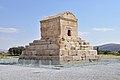
File:Pasargad_Tomb_Cyrus3.jpg|Achaemenid Empire | |||
File:Achaemenid_Empire_at_its_greatest_extent_according_to_Oxford_Atlas_of_World_History_2002.jpg|Achaemenid Empire | |||
File:Achaemenid_prince's_head_1.jpg|Achaemenid Empire | |||
File:Greek-Persian_duel.jpg|Achaemenid Empire | |||
File:Achaemenid_king_fighting_hoplites,_Cimmerian_Bosphorus_intaglio_(composite).jpg|Achaemenid Empire | |||
File:Achaemenid_gold_ornaments,70.142.6-.11.jpg|Achaemenid Empire | |||
File:Achaemenid_Empire.gif|Achaemenid Empire | |||
File:Darius_vase_Napoli_Museum_without_background.jpg|Achaemenid Empire | |||
File:Darius_detail_on_the_Darius_vase.jpg|Achaemenid Empire | |||
</gallery> | |||
<gallery> | <gallery> | ||
File:Achaemenid_plaque_from_Persepolis.JPG|Achaemenid Empire | File:Achaemenid_plaque_from_Persepolis.JPG|Achaemenid Empire | ||
Latest revision as of 12:02, 18 February 2025
Achaemenid Empire[edit]

The Achaemenid Empire was an ancient empire based in Western Asia, founded by Cyrus the Great in the 6th century BC. It is also known as the First Persian Empire. At its height, it encompassed territories in Anatolia, Egypt, parts of Greece, and as far east as the Indus Valley.
History[edit]
Foundation[edit]
The Achaemenid Empire was established by Cyrus the Great around 550 BC. Cyrus overthrew the Median Empire and expanded his dominion to include the Neo-Babylonian Empire, Lydia, and parts of Central Asia.
Expansion under Darius[edit]
Darius I, also known as Darius the Great, further expanded the empire. He reorganized the empire into satrapies, or provinces, and implemented a system of taxation. Darius also initiated the construction of Persepolis, the ceremonial capital of the empire.
Xerxes and the Greco-Persian Wars[edit]
Xerxes I, the son of Darius, is best known for his invasion of Greece in 480 BC. The Greco-Persian Wars included famous battles such as Thermopylae and Salamis. Despite initial successes, Xerxes' forces were eventually repelled by the Greek city-states.
Decline and Fall[edit]
The empire began to decline after the reign of Artaxerxes I. Internal strife, revolts, and the rise of Alexander the Great led to the eventual fall of the Achaemenid Empire. In 330 BC, Alexander defeated Darius III and effectively ended Achaemenid rule.
Culture and Society[edit]
The Achaemenid Empire was known for its cultural diversity and tolerance. It allowed various peoples within its borders to maintain their own customs and religions. The empire's administration was highly organized, with a network of roads and a postal system that facilitated communication across vast distances.
Architecture and Art[edit]

Achaemenid architecture is characterized by monumental structures such as Persepolis and the Tomb of Cyrus the Great at Pasargadae. The art of the Achaemenid period includes intricate reliefs, sculptures, and metalwork, often depicting scenes of royal power and divine favor.
Economy[edit]
The economy of the Achaemenid Empire was based on agriculture, trade, and tribute from conquered lands. The empire's extensive road network facilitated trade across its territories, connecting regions from the Mediterranean to India.
Military[edit]
The Achaemenid military was a formidable force, composed of various ethnic groups from across the empire. It included the famous Immortals, an elite infantry unit. The empire's navy played a crucial role in its campaigns against Greece.
Related pages[edit]
Gallery[edit]
-
 Achaemenid lineage
 -
 Achaemenid Empire under different kings
 -
 Achaemenid Empire at its greatest extent
 -
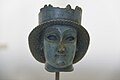 Achaemenid prince's head
 -
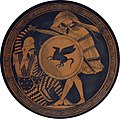 Greek-Persian duel
 -
 Achaemenid king fighting hoplites
 -
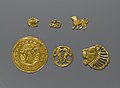 Achaemenid gold ornaments
 -
 Achaemenid Empire map
 -
 Darius vase

.svg)


.jpg)


Achaemenid Empire[edit]
-
 Achaemenid Empire
 -
Achaemenid Empire
-
Achaemenid Empire
-
 Achaemenid Empire
 -
Achaemenid Empire
-
Achaemenid Empire
-
Achaemenid Empire
-
Achaemenid Empire
-
Achaemenid Empire
-
Achaemenid Empire
-
Achaemenid Empire
-
 Achaemenid Empire

-
Achaemenid Empire
-
Achaemenid Empire
-
Achaemenid Empire
-
Achaemenid Empire
-
Achaemenid Empire
-
Achaemenid Empire
-
Achaemenid Empire
-
Achaemenid Empire
-
Achaemenid Empire
-
Achaemenid Empire
-
Achaemenid Empire
-
Achaemenid Empire
