Alternative splicing: Difference between revisions
CSV import Tags: mobile edit mobile web edit |
CSV import |
||
| Line 28: | Line 28: | ||
[[Category:Gene expression]] | [[Category:Gene expression]] | ||
{{genetics-stub}} | {{genetics-stub}} | ||
<gallery> | |||
File:DNA_alternative_splicing.gif|Alternative splicing | |||
File:Alt_splicing_bestiary2.jpg|Alternative splicing | |||
File:Splice_types_frequency.jpg|Alternative splicing | |||
File:Hyaluronidase3.gif|Alternative splicing | |||
File:A_complex.jpg|Alternative splicing | |||
File:Splicing_repression.jpg|Alternative splicing | |||
File:Splicing_activation.jpg|Alternative splicing | |||
File:Dsx_splicing.jpg|Alternative splicing | |||
File:transformer_splicing.gif|Alternative splicing | |||
File:Fas_alternative_splicing.jpg|Alternative splicing | |||
File:Tat_exon2_splicing.jpg|Alternative splicing | |||
</gallery> | |||
Latest revision as of 11:58, 18 February 2025
Alternative splicing is a regulated process during gene expression that results in a single gene coding for multiple proteins. This process is a key factor in the complexity of proteins in eukaryotes and is one of the main reasons why eukaryotes can have a relatively small number of genes but a much larger number of proteins.
Overview[edit]
In the process of transcription, the gene is copied into messenger RNA (mRNA). This mRNA then undergoes a process called splicing where introns (non-coding regions) are removed and exons (coding regions) are joined together. In alternative splicing, different combinations of exons are joined together to form different mRNAs, which are then translated into different proteins.
Mechanism[edit]
Alternative splicing can occur in several ways. The most common types are exon skipping, intron retention, mutually exclusive exons, and alternative 5' or 3' splice sites. The choice of which exons to include in the mRNA is determined by a complex set of regulatory signals in the DNA and RNA, as well as proteins and small RNAs in the cell.
Regulation[edit]
The regulation of alternative splicing is a complex process that involves numerous trans-acting factors and cis-acting elements. Trans-acting factors are proteins and small RNAs that bind to the mRNA and influence the splicing process. Cis-acting elements are sequences in the DNA or RNA that influence splicing.
Role in disease[edit]
Abnormal alternative splicing has been implicated in numerous diseases, including cancer, neurodegenerative diseases, and cardiovascular diseases. Understanding the mechanisms of alternative splicing and how it is regulated can therefore have important implications for the development of new treatments for these diseases.
See also[edit]

-
 Alternative splicing
 -
 Alternative splicing
 -
 Alternative splicing
 -
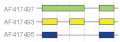 Alternative splicing
 -
 Alternative splicing
 -
 Alternative splicing
 -
 Alternative splicing
 -
 Alternative splicing
 -
 Alternative splicing
 -
 Alternative splicing
 -
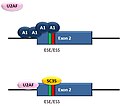 Alternative splicing


