Korean War: Difference between revisions
CSV import |
CSV import |
||
| Line 39: | Line 39: | ||
{{stub}} | {{stub}} | ||
<gallery> | |||
File:Korean_war_1950-1953.gif|Korean War | |||
File:South_Korean_refugees_mid-1950.jpg|South Korean refugees mid-1950 | |||
File:KumRiver_Howitzer.jpg|Kum River Howitzer | |||
File:KoreanWarFallenSoldier1.jpg|Korean War | |||
File:HA-SC-98-06983-Crew_of_M24_along_Naktong_River_front-Korean_war-17_Aug_1950.JPEG|Crew of M24 along Naktong River front, Korean War, 17 Aug 1950 | |||
File:A_U.S._Marine_tank_follows_a_line_of_prisoners_of_war_down_a_village_street._-_NARA_-_532408.tif|A U.S. Marine tank follows a line of prisoners of war down a village street | |||
File:Korean_War,_train_attack.jpg|Korean War, train attack | |||
File:China_Crosses_Yalu.jpg|China Crosses Yalu | |||
File:U.S._Army_machine_gun_team_near_the_Chongchon_River_in_North_Korea_(November_1950).jpg|U.S. Army machine gun team near the Chongchon River in North Korea (November 1950) | |||
File:Korean_War_bombing_Wonsan.jpg|Korean War bombing Wonsan | |||
File:U.S._Marines_in_the_Korean_War_003.jpg|U.S. Marines in the Korean War | |||
File:Centurion_tanks_and_infantry_of_the_Gloucestershire_Regiment_advancing_to_attack_Hill_327_in_Korea,_March_1951._BF454.jpg|Centurion tanks and infantry of the Gloucestershire Regiment advancing to attack Hill 327 in Korea, March 1951 | |||
</gallery> | |||
Latest revision as of 11:40, 18 February 2025
Korean War
The Korean War (Korean: 한국전쟁; Hanja: 韓國戰爭; RR: Hanguk Jeonjaeng; MR: Hanguk Chŏnjaeng), also known as the Fatherland Liberation War (Korean: 조국해방전쟁; Hanja: 祖國解放戰爭; RR: Joguk Haebang Jeonjaeng; MR: Choguk Haebang Chŏnjaeng), was a war fought in Korea from 1950 to 1953.
Background[edit]
The war began on 25 June 1950 when North Korea, supported by the Soviet Union and China, invaded South Korea, which was supported primarily by the United States. The war ended in a stalemate with the signing of the Korean Armistice Agreement on 27 July 1953.
Course of the War[edit]
The war was marked by large-scale battles, such as the Battle of Inchon, and significant movements of troops and equipment. The war also saw the first combat use of nuclear weapons by the United States, although these were not used on the Korean peninsula.
Aftermath[edit]
The war resulted in the division of Korea into two separate states, with the border between them, the Korean Demilitarized Zone, becoming one of the most heavily militarized borders in the world. The war also had significant effects on the global geopolitical landscape, contributing to the Cold War and the rise of Communism in East Asia.
See also[edit]
References[edit]
<references />
External links[edit]
 | |
|---|---|
 |
 |
-
 Korean War
 -
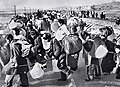 South Korean refugees mid-1950
 -
 Kum River Howitzer
 -
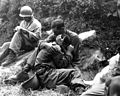 Korean War
 -
 Crew of M24 along Naktong River front, Korean War, 17 Aug 1950
 -
 A U.S. Marine tank follows a line of prisoners of war down a village street
 -
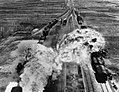 Korean War, train attack
 -
China Crosses Yalu
-
 U.S. Army machine gun team near the Chongchon River in North Korea (November 1950)
 -
 Korean War bombing Wonsan
 -
 U.S. Marines in the Korean War
 -
 Centurion tanks and infantry of the Gloucestershire Regiment advancing to attack Hill 327 in Korea, March 1951


.jpg)


