Nuclear receptor: Difference between revisions
CSV import Tags: mobile edit mobile web edit |
CSV import |
||
| Line 41: | Line 41: | ||
{{stub}} | {{stub}} | ||
==Nuclear_receptor== | |||
<gallery> | |||
File:PPARg_RXRa_3E00.png|PPARγ-RXRα complex structure | |||
File:NR_ligands.png|Nuclear receptor ligands | |||
File:Nuclear_Receptor_Structure.png|Nuclear receptor structure | |||
File:PR_DBD_2C7A.png|Progesterone receptor DNA-binding domain | |||
File:RORC_3L0L.png|RORC structure | |||
File:Nuclear_receptor_action.png|Nuclear receptor action | |||
File:Type_ii_nuclear_receptor_action.png|Type II nuclear receptor action | |||
File:NR_mechanism.png|Nuclear receptor mechanism | |||
File:Nr_alignment_tree.jpg|Nuclear receptor alignment tree | |||
</gallery> | |||
Latest revision as of 11:20, 18 February 2025
Nuclear receptors are a class of proteins found within cells that are responsible for sensing steroid and thyroid hormones and certain other molecules. In response, these receptors work with other proteins to regulate the expression of specific genes, thereby controlling the development, homeostasis, and metabolism of the organism.
Function[edit]
Nuclear receptors have the ability to directly bind to DNA and regulate the production of proteins encoded by specific genes. They are, therefore, classified as transcription factors. The regulation of gene expression by nuclear receptors generally involves the binding of the receptor to specific sequences of DNA, known as hormone response elements. Most of these receptors function as dimers, either as homodimers or heterodimers.
Classification[edit]
Nuclear receptors are classified into two main classes:
- Type I receptors dimerize with retinoid X receptor (RXR), bind to DNA in the absence of ligand, and are located in the nucleus.
- Type II receptors bind to DNA as monomers in the absence of ligand and are located in the cytosol. Upon ligand binding, they translocate into the nucleus.
Examples[edit]
Some examples of nuclear receptors include:
- Estrogen receptor
- Androgen receptor
- Progesterone receptor
- Glucocorticoid receptor
- Mineralocorticoid receptor
- Thyroid hormone receptor
- Retinoic acid receptor
- Vitamin D receptor
Clinical significance[edit]
Nuclear receptors play an essential role in human physiology, and hence, alterations in their function can lead to a wide array of pathologies, including cancer, diabetes, thyroid disease, and certain genetic disorders.
See also[edit]
 | |
|---|---|
 |
 |
Nuclear_receptor[edit]
-
 PPARγ-RXRα complex structure
 -
 Nuclear receptor ligands
 -
 Nuclear receptor structure
 -
 Progesterone receptor DNA-binding domain
 -
 RORC structure
 -
 Nuclear receptor action
 -
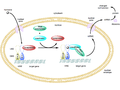 Type II nuclear receptor action
 -
 Nuclear receptor mechanism
 -
 Nuclear receptor alignment tree


