Cellulose: Difference between revisions
m 1 revision imported |
CSV import |
||
| Line 13: | Line 13: | ||
[[Category:Molecular biology]] | [[Category:Molecular biology]] | ||
[[Category:Biochemistry]] | [[Category:Biochemistry]] | ||
<gallery> | |||
File:Cellulose_Sessel.svg|Cellulose molecular structure | |||
File:Plant_cell_wall_diagram-en.svg|Diagram of a plant cell wall | |||
File:Салфетка_универсальная_губчатая_(вид_сбоку).jpg|Sponge cloth side view | |||
File:Cellulose_spacefilling_model.jpg|Cellulose space-filling model | |||
File:Cotton.JPG|Cotton plant | |||
File:Cellulose_strand.svg|Cellulose strand | |||
</gallery> | |||
Latest revision as of 11:06, 18 February 2025
Cellulose is the main chemical that forms the main structure of plants. It is the most abundant macromolecule on Earth. It is also a fibre.
Cellulose is made from a form of glucose and makes up most of the cell wall of plant cells. This is what keeps a plant in shape. Humans and other animals cannot digest cellulose but some animals such as termites and ruminants use bacteria to digest it.
It is a polysaccharide, which is repeating units of a monosaccharide joined together by a glycosidic bond by a condensation reaction, there is a by-product of water, found in plants. It is very tough because when you join beta glucose together, they are opposite ways up, the bonds are straight, forming straight chains. There is hydrogen bonds between the polymers.
These fibers are in bundles of about 40, called microfibrils. Microfibrils are embedded in a hydrated network of other polysaccharides. The cell wall is assembled in place. The parts are made inside the cell and then assembled by enzymes associated with the cell membrane.

-
 Cellulose molecular structure
 -
 Diagram of a plant cell wall
 -
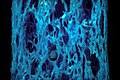 Sponge cloth side view
 -
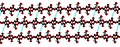 Cellulose space-filling model
 -
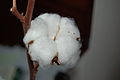 Cotton plant
 -
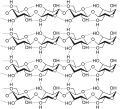 Cellulose strand


.jpg)


