Lysimachia clethroides: Difference between revisions
CSV import |
CSV import |
||
| Line 22: | Line 22: | ||
{{Invasive species}} | {{Invasive species}} | ||
{{Medicine-stub}} | {{Medicine-stub}} | ||
<gallery> | |||
File:Lysimachia_clethroides._06-08-2020_(d.j.b.)_01.jpg|Lysimachia clethroides | |||
File:Lysimachia_clethroides_01.JPG|Lysimachia clethroides | |||
File:Klaffer_-_Kräutergarten_-_Schnee-Felberich_(Lysimachia_clethroides)_-_2.jpg|Lysimachia clethroides | |||
File:Lysimachia_clethroides_02.JPG|Lysimachia clethroides | |||
File:Lysimachia_clethroides_04.JPG|Lysimachia clethroides | |||
File:LAUFER_Goosneck_Loosestrife.jpg|Lysimachia clethroides | |||
</gallery> | |||
Latest revision as of 11:02, 18 February 2025
Lysimachia clethroides, commonly known as Gooseneck Loosestrife, is a species of flowering plant in the family Primulaceae. It is native to China and Japan, but has been introduced to other parts of the world as an ornamental plant.
Description[edit]
Lysimachia clethroides is a perennial plant that grows to a height of 60–120 cm. The leaves are lanceolate, up to 10 cm long and 2 cm broad, with a smooth edge and a pointed tip. The flowers are white, produced on a terminal spike 10–20 cm long with a distinctive gooseneck shape.
Cultivation[edit]
Lysimachia clethroides is grown as an ornamental plant for its attractive spikes of white flowers. It is hardy to USDA zones 4–8. It prefers full sun to partial shade and moist, well-drained soil. It can be propagated by seed, division, or cuttings.
Uses[edit]
In traditional Chinese medicine, Lysimachia clethroides is used to treat urinary tract infections and other ailments. It is also used in the floral industry for its distinctive flower spikes.
Invasive species[edit]
In some areas, such as the northeastern United States, Lysimachia clethroides has escaped cultivation and become an invasive species. It can form dense stands that displace native vegetation and alter habitats.
See also[edit]
| Invasive species | ||||||||||
|---|---|---|---|---|---|---|---|---|---|---|
This invasive species related article is a stub.
|

-
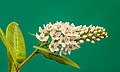 Lysimachia clethroides
 -
 Lysimachia clethroides
 -
 Lysimachia clethroides
 -
 Lysimachia clethroides
 -
 Lysimachia clethroides
 -
 Lysimachia clethroides
_01.jpg)

_-_2.jpg)


