Glycosidic bond: Difference between revisions
CSV import |
CSV import |
||
| Line 31: | Line 31: | ||
{{stub}} | {{stub}} | ||
<gallery> | |||
File:Ethyl-glucoside.png|Ethyl glucoside | |||
File:Adenosin.svg|Adenosine | |||
File:Beta-1,6-linkage.svg|Beta-1,6 linkage | |||
File:Vishal_Joshi.png|Glycosidic bond | |||
File:Glucosidase-catalyzed_glycosidation_of_D-Glucose_to_Ethyl_β-D-glucopyranoside.png|Glucosidase-catalyzed glycosidation of D-Glucose to Ethyl β-D-glucopyranoside | |||
File:Fluorine.Directed.Glycosylation.tif|Fluorine Directed Glycosylation | |||
File:Control_of_Oxonium_ion_-_Felkin-Ahn_stereoselectivity_.png|Control of Oxonium ion - Felkin-Ahn stereoselectivity | |||
File:Control_of_Oxonium_ion_-_Felkin-Ahn_stereoselectivity2.png|Control of Oxonium ion - Felkin-Ahn stereoselectivity | |||
</gallery> | |||
Latest revision as of 10:55, 18 February 2025
Glycosidic bond is a type of covalent bond that joins a carbohydrate (sugar) molecule to another group, which may or may not be another carbohydrate.
Overview[edit]
A glycosidic bond is formed between the anomeric carbon of a carbohydrate and the hydroxyl group of another molecule. The bond is synthesized by dehydration synthesis, which involves the elimination of a water molecule from the functional groups that form the bond.
Types of Glycosidic Bonds[edit]
There are two types of glycosidic bonds: alpha (α) and beta (β). The distinction between the two is based on the position of the bonded carbon atom.
Alpha Glycosidic Bond[edit]
In an alpha glycosidic bond, the OH group on the anomeric carbon is on the opposite side (trans) of the ring oxygen from the CH2OH moiety. This is the case in starch and glycogen.
Beta Glycosidic Bond[edit]
In a beta glycosidic bond, the OH group on the anomeric carbon is on the same side (cis) of the ring oxygen as the CH2OH moiety. This is the case in cellulose and chitin.
Role in Biology[edit]
Glycosidic bonds play a crucial role in the structure and function of carbohydrates in living organisms. They are responsible for the formation of disaccharides and polysaccharides, and they also play a role in the formation of DNA and RNA.
See Also[edit]
 | |
|---|---|
 |
 |
-
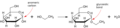 Ethyl glucoside
 -
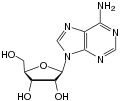 Adenosine
 -
 Beta-1,6 linkage
 -
 Glycosidic bond
 -
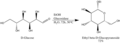 Glucosidase-catalyzed glycosidation of D-Glucose to Ethyl β-D-glucopyranoside
 -
 Fluorine Directed Glycosylation
 -
 Control of Oxonium ion - Felkin-Ahn stereoselectivity
 -
 Control of Oxonium ion - Felkin-Ahn stereoselectivity


