Uruli: Difference between revisions
CSV import |
CSV import Tags: mobile edit mobile web edit |
||
| Line 34: | Line 34: | ||
[[Category:Indian cookware]] | [[Category:Indian cookware]] | ||
[[Category:Kerala culture]] | [[Category:Kerala culture]] | ||
<gallery> | |||
File:Urulies.JPG|Uruli | |||
File:Uruli_medium.JPG|Uruli | |||
File:Uruli_large.JPG|Uruli | |||
</gallery> | |||
Revision as of 05:04, 18 February 2025
Traditional cookware of Kerala, India
Uruli (Malayalam: _____) is a traditional cookware extensively used in the Indian state of Kerala and in some parts of Tamil Nadu. It is made of bell metal, a type of bronze, and is known for its durability and heat retention properties. Urulis are commonly used for cooking, serving, and even for decorative purposes.
History
The use of urulis dates back several centuries in South India. Traditionally, they were crafted by skilled artisans using a combination of copper and tin, which gives the metal its characteristic golden hue. Urulis were an essential part of the kitchen in Kerala households, especially during festivals and special occasions.
Design and Manufacture
Urulis are typically round and shallow with a flat base and slightly curved sides. They come in various sizes, from small ones used for cooking curries to large ones used for preparing feasts. The manufacturing process involves casting the metal in molds and then finishing it by hand to achieve a smooth surface.
Uses
Urulis are versatile and can be used for cooking a variety of dishes, including payasam, a traditional sweet dish, and sambar, a popular lentil-based stew. Due to their aesthetic appeal, urulis are also used as decorative items, often filled with water and flowers, in homes and hotels.
Cultural Significance
In Kerala, urulis hold cultural significance and are often passed down as family heirlooms. They are also used in traditional Ayurvedic practices for preparing herbal medicines.
Gallery
-
 Different sizes of urulis
 -
 Medium-sized uruli
 -
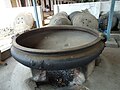 Large uruli used for cooking


Related pages
References
- Menon, A. Sreedhara. A Survey of Kerala History. DC Books, 2007.
- Nair, K. R. Gopalakrishna. Kerala: A Cultural Paradise. Penguin Books, 2015.
-
Uruli
-
Uruli
-
Uruli
