Kinpira: Difference between revisions
CSV import |
CSV import Tags: mobile edit mobile web edit |
||
| Line 29: | Line 29: | ||
[[Category:Cooking techniques]] | [[Category:Cooking techniques]] | ||
{{Japanese-food-stub}} | {{Japanese-food-stub}} | ||
<gallery> | |||
File:Burdockgobo.jpg|Burdock root | |||
File:Celery_Kinpira.jpg|Celery Kinpira | |||
</gallery> | |||
Latest revision as of 04:59, 18 February 2025
Kinpira is a traditional Japanese cooking style that involves stir-frying and simmering ingredients. The term "kinpira" comes from the legendary strongman, Kintaro, due to the strong, bold flavors typically associated with this method of cooking.
History[edit]
The origins of kinpira are not well-documented, but it is believed to have been developed during the Edo period in Japan. The cooking style is named after the folk hero Kintaro, who was known for his extraordinary strength. The robust flavors of kinpira dishes are thought to reflect the strength of Kintaro.
Preparation[edit]
Kinpira is typically prepared by first stir-frying the ingredients, usually vegetables such as carrots, burdock root, and lotus root, in sesame oil. The vegetables are then simmered with soy sauce, mirin, and sugar until they are tender and the flavors have melded together. Some variations of kinpira also include meat, such as beef or chicken.
Variations[edit]
There are many variations of kinpira, both within Japan and in other countries. Some common variations include:
- Kinpira gobo: This is perhaps the most well-known version of kinpira, made with burdock root and carrot.
- Kinpira renkon: This version uses lotus root as the main ingredient.
- Kinpira daikon: This version uses daikon radish as the main ingredient.
Cultural Significance[edit]
Kinpira is a staple in Japanese home cooking and is often included in bento boxes due to its long shelf life. It is also commonly served as a side dish in Izakayas, casual Japanese pubs.
See Also[edit]

-
 Burdock root
 -
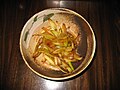 Celery Kinpira


