Tyrosine kinase: Difference between revisions
CSV import |
CSV import Tags: mobile edit mobile web edit |
||
| Line 41: | Line 41: | ||
[[Category:Signal transduction]] | [[Category:Signal transduction]] | ||
[[Category:Tyrosine kinases]] | [[Category:Tyrosine kinases]] | ||
== Tyrosine_kinase == | |||
<gallery> | |||
File:Hck_protein_tyrosine_kinase.png|Hck protein tyrosine kinase | |||
File:Tyrosine_kinase.png|Tyrosine kinase | |||
File:L-tyrosine-skeletal.png|L-tyrosine skeletal structure | |||
File:Phosphate_Group.svg|Phosphate group | |||
File:ATP_structure_revised.svg|ATP structure | |||
</gallery> | |||
Latest revision as of 04:57, 18 February 2025
Tyrosine Kinase[edit]

Tyrosine kinases are a subclass of protein kinases that specifically phosphorylate the amino acid tyrosine on target proteins. This phosphorylation event is a critical mechanism for regulating cellular processes, including cell division, growth, and apoptosis.
Structure[edit]

Tyrosine kinases are characterized by a conserved catalytic domain that facilitates the transfer of a phosphate group from adenosine triphosphate (ATP) to the hydroxyl group of tyrosine residues on substrate proteins. This domain typically contains an ATP-binding site and a substrate-binding site, which are crucial for its enzymatic activity.
Function[edit]
Tyrosine kinases play a pivotal role in signal transduction pathways. Upon activation, they initiate a cascade of downstream signaling events that can lead to various cellular responses. These kinases are involved in the regulation of numerous cellular functions, such as metabolism, transcription, and cell cycle progression.
Types[edit]
Tyrosine kinases can be broadly classified into two categories:
- Receptor tyrosine kinases (RTKs): These are membrane-bound receptors that, upon binding to their specific ligands, undergo dimerization and autophosphorylation, activating their kinase activity. Examples include the epidermal growth factor receptor (EGFR) and the insulin receptor.
- Non-receptor (cytoplasmic) tyrosine kinases: These kinases are located in the cytoplasm and are involved in signaling pathways initiated by receptor tyrosine kinases or other receptors. An example is the Src family kinases, which includes Hck (hematopoietic cell kinase).
Clinical Significance[edit]
Dysregulation of tyrosine kinase activity is implicated in various diseases, particularly cancer. Overexpression or mutation of tyrosine kinases can lead to uncontrolled cell proliferation. As a result, tyrosine kinase inhibitors (TKIs) have been developed as targeted therapies for certain types of cancer, such as chronic myeloid leukemia and non-small cell lung cancer.
Related Pages[edit]
References[edit]
Tyrosine_kinase[edit]
-
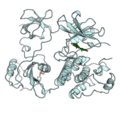 Hck protein tyrosine kinase
 -
 Tyrosine kinase
 -
 L-tyrosine skeletal structure
 -
 Phosphate group
 -
 ATP structure


