Carpometacarpal joint: Difference between revisions
CSV import Tags: mobile edit mobile web edit |
CSV import |
||
| Line 26: | Line 26: | ||
[[Category:Joints]] | [[Category:Joints]] | ||
{{anatomy-stub}} | {{anatomy-stub}} | ||
<gallery> | |||
File:Gray335.png|Carpometacarpal joint | |||
File:RightHumanAnteriorDistalRadiusUlnaCarpals.jpg|Carpometacarpal joint | |||
File:Gray336.png|Carpometacarpal joint | |||
File:Hand_1_1.jpg|Carpometacarpal joint | |||
</gallery> | |||
Latest revision as of 04:54, 18 February 2025
Carpometacarpal Joint
The carpometacarpal joint (CMC) is one of the five joints in the human hand. It is located at the base of the hand, connecting the carpal bones of the wrist to the metacarpal bones of the fingers. The CMC joint is particularly important for thumb movement, as it allows for a wide range of motion.
Anatomy[edit]
The CMC joint is a type of saddle joint, which is characterized by two bones that fit together in a way that allows for movement in multiple directions. The joint is formed by the articulation of the trapezium bone in the wrist and the first metacarpal bone of the thumb. This unique structure allows for a high degree of flexibility and dexterity in the thumb.
Function[edit]
The primary function of the CMC joint is to facilitate movement of the thumb. This includes flexion and extension (moving the thumb towards and away from the palm), abduction and adduction (moving the thumb away from and towards the other fingers), and opposition (touching the thumb to the tips of the other fingers). These movements are essential for many daily activities, such as gripping objects, writing, and using tools.
Clinical Significance[edit]
Due to its high use and mobility, the CMC joint is susceptible to various conditions and injuries. Osteoarthritis of the CMC joint, also known as thumb arthritis, is a common condition that causes pain, stiffness, and reduced function. Other conditions that can affect the CMC joint include fractures, dislocations, and ligament injuries. Treatment options for these conditions range from conservative measures such as rest and physical therapy to surgical interventions.
See Also[edit]

-
 Carpometacarpal joint
 -
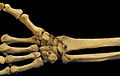 Carpometacarpal joint
 -
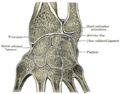 Carpometacarpal joint
 -
 Carpometacarpal joint


