Namibian cuisine: Difference between revisions
CSV import |
CSV import |
||
| Line 24: | Line 24: | ||
{{African-cuisine-stub}} | {{African-cuisine-stub}} | ||
{{food-stub}} | {{food-stub}} | ||
== Namibian_cuisine == | |||
<gallery> | |||
File:Grilled_game.JPG|Grilled game meat | |||
File:LocationNamibia.svg|Map of Namibia | |||
File:Braai.jpg|Traditional Namibian braai | |||
File:WindhoekBaeckereiCarstensen.jpg|Bakery in Windhoek | |||
</gallery> | |||
Latest revision as of 04:53, 18 February 2025
Namibian Cuisine is the style of cooking practiced by the Namibian people. It is characterized by the extensive use of indigenous fruits, vegetables, and grains, as well as meat from both domesticated and wild animals. The cuisine is influenced by a variety of cultures, including the indigenous San, Damara, and Herero, as well as influences from German, British, and South African cuisines.
History[edit]
Namibian cuisine has a rich history that dates back to the early San hunter-gatherers. The San people, also known as Bushmen, were the first inhabitants of Namibia and their diet consisted mainly of wild fruits, roots, and meat from hunting. With the arrival of the Bantu-speaking Herero and Damara in the 14th and 15th centuries, the diet expanded to include domesticated cattle and crops such as millet.
The cuisine was further influenced by the arrival of European settlers in the 19th century. The German influence is particularly evident in the popularity of meat, especially game meat, and baked goods like bread and pastries.
Common Ingredients[edit]
The Namibian diet is rich in meat, particularly beef, mutton, and game meat from animals such as kudu, oryx, and springbok. Fish, especially from the Atlantic and the Caprivi region's rivers, is also a staple.
Crops such as maize, millet, and sorghum are commonly used, along with a variety of fruits and vegetables. The marula fruit is particularly popular and is used to make a traditional alcoholic drink called Ombike.
Popular Dishes[edit]
One of the most popular dishes in Namibian cuisine is Biltong, a type of dried, cured meat that originated in South Africa. Another popular dish is Kapana, which is street food consisting of spiced, grilled meat.
Potjiekos is a traditional stew made with meat and vegetables and cooked in a three-legged pot over an open fire. Mopane worms, a type of caterpillar, are also a common source of protein and are often dried and used in stews.
See Also[edit]


Namibian_cuisine[edit]
-
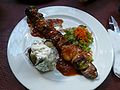 Grilled game meat
 -
 Map of Namibia
 -
 Traditional Namibian braai
 -
 Bakery in Windhoek


