G2 phase: Difference between revisions
CSV import |
CSV import |
||
| Line 30: | Line 30: | ||
[[Category:Cell biology]] | [[Category:Cell biology]] | ||
[[Category:Cell cycle]] | [[Category:Cell cycle]] | ||
<gallery> | |||
File:Animal_cell_cycle-en.svg|Diagram of the animal cell cycle | |||
File:Human_karyotype_with_bands_and_sub-bands.png|Human karyotype with bands and sub-bands | |||
File:G2-M_feedback_loops.png|G2-M feedback loops | |||
File:G2-M_Bistability.png|G2-M Bistability | |||
</gallery> | |||
Latest revision as of 04:52, 18 February 2025
G2 phase is the third, penultimate phase of the cell cycle, the sequence of events that a cell goes through as it grows and divides. The G2 phase directly precedes the M phase, during which the cell actually splits into two daughter cells.
Overview[edit]
The G2 phase follows the S phase, during which the cell's DNA is replicated. During the G2 phase, the cell undergoes the final preparations for mitosis. This includes the synthesis of proteins necessary for mitosis and the checking and repair of the replicated DNA.
Duration[edit]
The length of the G2 phase can vary greatly, but on average it lasts about 4 to 5 hours in mammalian cells. In some cells, the G2 phase is omitted entirely, allowing the cell to proceed directly from S phase to mitosis.
Regulation[edit]
The progression of the cell cycle, including the transition from G2 phase to mitosis, is tightly regulated by a complex network of proteins. These include cyclins, cyclin-dependent kinases (CDKs), and checkpoint kinases, among others. Disruptions in this regulatory network can lead to uncontrolled cell growth and division, a hallmark of cancer.
See also[edit]
References[edit]
<references />
 | This medical article is a stub. You can help WikiMD by expanding the page. |
-
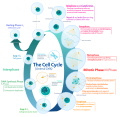 Diagram of the animal cell cycle
 -
 Human karyotype with bands and sub-bands
 -
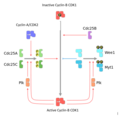 G2-M feedback loops
 -
 G2-M Bistability


