Spermatogonium: Difference between revisions
CSV import Tags: mobile edit mobile web edit |
CSV import |
||
| Line 30: | Line 30: | ||
{{biology-stub}} | {{biology-stub}} | ||
{{medicine-stub}} | {{medicine-stub}} | ||
<gallery> | |||
File:Germinal_epithelium_testicle.svg|Germinal epithelium of the testicle | |||
File:Testicle-histology-boar.jpg|Histology of a boar testicle | |||
File:Gray1150.png|Diagram of the male reproductive system | |||
File:Spermatocytogenesis.png|Diagram of spermatocytogenesis | |||
</gallery> | |||
Latest revision as of 04:45, 18 February 2025
Spermatogonium (plural: spermatogonia) is a type of germ cell that is found in the testis. It is the earliest stage in the process of spermatogenesis, which is the production of spermatozoa or sperm cells.
Overview[edit]
Spermatogonia are located in the outermost layer of the seminiferous tubules, which are the site of sperm production in the testes. They are diploid cells, meaning they contain two sets of chromosomes.
Types of Spermatogonia[edit]
There are three types of spermatogonia: Type A dark (Ad), Type A pale (Ap), and Type B.
- Type A dark (Ad) spermatogonia are reserve cells. They do not usually undergo cell division, but they can be called upon to produce more spermatogonia if needed.
- Type A pale (Ap) spermatogonia are proliferative cells. They undergo regular cycles of cell division to produce more spermatogonia.
- Type B spermatogonia are transitional cells. They divide to produce primary spermatocytes, which are the next stage in spermatogenesis.
Spermatogenesis[edit]
Spermatogenesis is the process by which spermatogonia develop into mature spermatozoa. This process involves several stages:
- Mitosis of spermatogonia: The spermatogonia undergo mitosis, a type of cell division that results in two identical daughter cells. This allows the population of spermatogonia to be replenished.
- Meiosis of spermatocytes: The primary spermatocytes produced by the Type B spermatogonia undergo meiosis, a type of cell division that results in four daughter cells, each with half the number of chromosomes of the parent cell. This produces haploid cells, which are necessary for sexual reproduction.
- Spermiogenesis: The haploid cells produced by meiosis, called spermatids, undergo a process of maturation called spermiogenesis to become mature spermatozoa.
Clinical Significance[edit]
Abnormalities in the spermatogonia or in the process of spermatogenesis can lead to infertility in males. For example, some forms of testicular cancer can originate from spermatogonia.


-
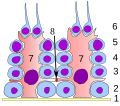 Germinal epithelium of the testicle
 -
 Histology of a boar testicle
 -
 Diagram of the male reproductive system
 -
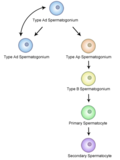 Diagram of spermatocytogenesis


