Sulci: Difference between revisions
CSV import Tags: mobile edit mobile web edit |
CSV import Tags: mobile edit mobile web edit |
||
| Line 21: | Line 21: | ||
{{medicine-stub}} | {{medicine-stub}} | ||
<gallery> | |||
File:Sulky_arcaica.jpg|Sulci | |||
File:Leone_(Sulcis).jpg|Leone in Sulci | |||
File:DRUSO_MINORE_DA_SULCIS_2.jpg|Druso Minore da Sulci | |||
File:Tofet_di_Sant'Antioco.JPG|Tofet di Sant'Antioco | |||
</gallery> | |||
Latest revision as of 04:38, 18 February 2025
Sulci are grooves or furrows found on the surface of the brain, serving as important landmarks that divide the brain into lobes and also into smaller regions. They are part of the brain's cerebral cortex, which is involved in many high-level functions such as memory, attention, perception, cognition, awareness, thought, language, and consciousness. Sulci play a crucial role in increasing the surface area of the cerebral cortex, allowing for a greater number of neurons to be accommodated within the limited space of the skull. This increase in surface area is associated with enhanced cognitive abilities.
Anatomy and Function[edit]
The brain's surface is marked by a series of ridges and grooves. The ridges are known as gyri (singular: gyrus), while the grooves are referred to as sulci (singular: sulcus). The presence of these structures contributes to the characteristic wrinkled appearance of the brain. Among the most prominent sulci are the central sulcus, which separates the frontal lobe from the parietal lobe, and the lateral sulcus (also known as the Sylvian fissure), which divides the temporal lobe from the frontal and parietal lobes.
Sulci serve not only as physical landmarks but also as boundaries for functional areas of the brain. For example, the central sulcus separates the primary motor cortex, located in the frontal lobe, from the primary somatosensory cortex, located in the parietal lobe. This separation is crucial for the organization and execution of motor functions and the processing of sensory information.
Development[edit]
The development of sulci begins in the late stages of fetal development and continues into early childhood. This process, known as cortical folding, is influenced by both genetic and environmental factors. The pattern of sulci and gyri is unique to each individual, although certain sulci are consistent across individuals, allowing them to be used as landmarks for neuroimaging and neurosurgery.
Clinical Significance[edit]
Abnormalities in the development of sulci and gyri can be indicators of neurological or developmental disorders. For instance, a lack of normal cortical folding, known as lissencephaly, is associated with severe intellectual disability and epilepsy. Conversely, excessive folding can be seen in conditions such as polymicrogyria. The study of sulci and their patterns can also aid in the diagnosis and treatment planning for conditions such as epilepsy, brain tumors, and cerebrovascular accidents (strokes).
See Also[edit]

-
 Sulci
Sulci -
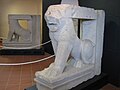 Leone in Sulci
 -
 Druso Minore da Sulci
 -
 Tofet di Sant'Antioco

.jpg)


