Artificial bone: Difference between revisions
CSV import |
CSV import |
||
| Line 58: | Line 58: | ||
[[Category:Orthopedic surgical procedures]] | [[Category:Orthopedic surgical procedures]] | ||
[[Category:Dental materials]] | [[Category:Dental materials]] | ||
<gallery> | |||
File:Hydrogel-HA.jpg|Hydrogel-HA composite used in artificial bone applications | |||
File:The_use_of_Solid_Freeform_Fabrication_in_design_of_composite_scaffolds.png|Solid Freeform Fabrication in design of composite scaffolds | |||
File:Structure_of_Chitin.png|Structure of Chitin | |||
File:Preparation_of_chitin_and_chitosan_from_marine_crustaceans.png|Preparation of chitin and chitosan from marine crustaceans | |||
</gallery> | |||
Revision as of 04:38, 18 February 2025
Synthetic bone substitute used in medical applications
Artificial bone is a synthetic material designed to mimic the properties of natural bone and is used in various medical applications, including bone grafting, orthopedic surgery, and dental implants. Artificial bones are engineered to support bone regeneration and repair, providing a scaffold for new bone growth and integration with existing bone tissue.
Composition and Types
Artificial bones are typically composed of materials that are biocompatible and have similar mechanical properties to natural bone. Common materials used include:
- Hydroxyapatite: A naturally occurring mineral form of calcium apatite, hydroxyapatite is a major component of bone mineral and teeth. It is often used in artificial bone due to its excellent biocompatibility and osteoconductivity.
- Calcium phosphate: This material is similar to hydroxyapatite and is used in various forms, such as tricalcium phosphate, to create porous structures that facilitate bone ingrowth.
- Bioglass: A type of bioactive glass that bonds with bone and stimulates bone growth. It is used in bone grafts and coatings for implants.
- Polymers: Synthetic polymers such as polylactic acid (PLA) and polyglycolic acid (PGA) are used to create biodegradable scaffolds that support bone regeneration.
Applications
Artificial bones are used in a variety of medical procedures, including:
- Bone grafting: Artificial bone can be used as a substitute for autografts or allografts, reducing the need for donor tissue and associated complications.
- Orthopedic surgery: In procedures such as joint replacement and spinal fusion, artificial bone materials are used to fill bone defects and support the integration of implants.
- Dental implants: Artificial bone is used to augment the jawbone, providing a stable foundation for dental implants.
Advantages
The use of artificial bone offers several advantages over traditional bone grafts:
- Availability: Artificial bone is readily available and does not require harvesting from the patient or a donor.
- Reduced risk of disease transmission: Unlike allografts, artificial bone does not carry the risk of transmitting infectious diseases.
- Customizability: Artificial bone can be engineered to match the specific needs of a patient, including shape, size, and mechanical properties.
Challenges
Despite its advantages, the use of artificial bone also presents challenges:
- Integration: Ensuring that artificial bone integrates well with natural bone tissue is critical for long-term success.
- Mechanical properties: Matching the mechanical properties of natural bone, such as strength and elasticity, is essential to prevent implant failure.
- Biodegradability: The rate of degradation of artificial bone must be carefully controlled to match the rate of new bone formation.
Future Directions
Research in artificial bone is focused on improving materials and techniques to enhance bone regeneration and integration. Advances in 3D printing and tissue engineering are enabling the creation of more complex and patient-specific bone substitutes.
Related pages
Gallery
-
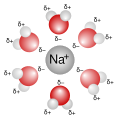 Illustration of sodium ions in aqueous solution, relevant to the chemical processes in bone mineralization.

-
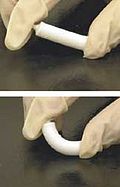 Hydrogel-HA composite used in artificial bone applications
 -
 Solid Freeform Fabrication in design of composite scaffolds
 -
 Structure of Chitin
 -
 Preparation of chitin and chitosan from marine crustaceans


