Terphenyl: Difference between revisions
CSV import Tags: mobile edit mobile web edit |
CSV import |
||
| Line 28: | Line 28: | ||
{{Chemistry-stub}} | {{Chemistry-stub}} | ||
<gallery> | |||
File:Para-terphenyl.png|Para-terphenyl | |||
File:Ortho-terphenyl.png|Ortho-terphenyl | |||
File:Meta-terphenyl.png|Meta-terphenyl | |||
File:Para-terphenyl.png|Para-terphenyl | |||
</gallery> | |||
Latest revision as of 04:37, 18 February 2025
Terphenyl is a class of aromatic hydrocarbon compounds, characterized by a structure consisting of three benzene rings connected by single carbon-carbon bonds. The simplest member of this class is ortho-terphenyl (o-terphenyl), which has the three benzene rings in a linear arrangement. Other isomers include meta-terphenyl (m-terphenyl) and para-terphenyl (p-terphenyl), which differ in the relative positions of the benzene rings. Terphenyls are used in a variety of applications, ranging from organic synthesis to the production of heat transfer fluids.
Structure and Isomerism[edit]
Terphenyl compounds exhibit structural isomerism, with the three main isomers being:
- Ortho-terphenyl (o-Terphenyl): The benzene rings are connected in a linear sequence.
- Meta-terphenyl (m-Terphenyl): The first and third benzene rings are connected to opposite sides of the central benzene ring.
- Para-terphenyl (p-Terphenyl): The benzene rings are connected at the ends, forming a U-shape.
Synthesis[edit]
Terphenyls can be synthesized through various organic reactions, including the Friedel-Crafts alkylation of benzene with chlorobenzene in the presence of a Lewis acid catalyst. This method can produce different terphenyl isomers depending on the reaction conditions and the catalysts used.
Applications[edit]
Terphenyl compounds have diverse applications in the chemical industry. They are used as intermediates in the synthesis of dyes, pharmaceuticals, and other organic compounds. Para-terphenyl, in particular, is used as a high-temperature heat transfer fluid due to its stability at high temperatures. Terphenyls are also used in the manufacture of polychlorinated biphenyls (PCBs), which were widely used as dielectric and coolant fluids in electrical apparatus before their production was banned due to environmental concerns.
Environmental and Health Concerns[edit]
While terphenyls themselves are not as hazardous as some of their chlorinated derivatives, they can pose environmental and health risks under certain conditions. Polychlorinated biphenyls (PCBs), which can be produced from terphenyls, are persistent organic pollutants that have been linked to various health issues, including cancer and immune system suppression.
See Also[edit]
References[edit]
<references/>

-
 Para-terphenyl
 -
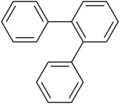 Ortho-terphenyl
 -
 Meta-terphenyl
 -
Para-terphenyl


