White chocolate: Difference between revisions
CSV import Tags: mobile edit mobile web edit |
CSV import |
||
| Line 20: | Line 20: | ||
[[Category:Swiss inventions]] | [[Category:Swiss inventions]] | ||
{{food-stub}} | {{food-stub}} | ||
<gallery> | |||
File:Milkybar-Split.jpg|Milkybar split | |||
File:Milky_Bar_Ad.jpg|Milky Bar advertisement | |||
File:White_chocolate_with_rose_petals.jpg|White chocolate with rose petals | |||
File:White_chocolate_in_a_tempering_wheel.jpg|White chocolate in a tempering wheel | |||
File:Ailin25VeganRiceChocolate.JPG|White chocolate | |||
</gallery> | |||
Latest revision as of 04:36, 18 February 2025
White chocolate is a type of chocolate that is primarily made from cocoa butter, sugar, and milk solids. Unlike other types of chocolate, white chocolate does not contain cocoa solids, which are derived from the cocoa bean. This gives white chocolate its distinctive color and flavor.
History[edit]
The origins of white chocolate can be traced back to Switzerland in the 1930s. It was first introduced by the Nestlé company as a luxury item. The product was developed in response to a surplus of milk powder during World War II. Since then, white chocolate has become a popular ingredient in a variety of confectionery products.
Production[edit]
The production of white chocolate involves several steps. First, the cocoa beans are harvested and the cocoa butter is extracted. The cocoa butter is then combined with sugar and milk solids to create a smooth, creamy mixture. This mixture is then tempered, or heated and cooled, to give the chocolate its characteristic texture and shine. Finally, the chocolate is molded into bars or other shapes and allowed to cool and harden.
Flavor and Uses[edit]
White chocolate has a sweet, creamy flavor that is less bitter than other types of chocolate. It is often used in baking and dessert recipes, such as white chocolate chip cookies and white chocolate mousse. It can also be used in savory dishes, such as white chocolate and truffle risotto.
Health Aspects[edit]
While white chocolate contains beneficial nutrients such as calcium and antioxidants, it is also high in saturated fat and sugar. Therefore, it should be consumed in moderation as part of a balanced diet.
Regulations[edit]
In many countries, including the United States and the European Union, white chocolate must contain at least 20% cocoa butter and 14% milk solids to be legally sold as "white chocolate". This ensures that the product has a certain level of quality and flavor.

-
 Milkybar split
 -
 Milky Bar advertisement
 -
 White chocolate with rose petals
 -
 White chocolate in a tempering wheel
 -
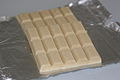 White chocolate


