Pork belly: Difference between revisions
CSV import |
CSV import |
||
| Line 26: | Line 26: | ||
{{food-stub}} | {{food-stub}} | ||
<gallery> | |||
File:Schweinebauch-2.jpg|Pork belly | |||
File:BraisedPorkBelly.JPG|Braised pork belly | |||
File:Rauchfleisch_Bohnakern_Klöß_(2).jpg|Pork belly with beans and dumplings | |||
File:Pork_Belly_Char_Siu_with_Rice.jpg|Pork belly char siu with rice | |||
File:Lechong_Kawali_at_La_Herencia_Comida.jpg|Lechong kawali | |||
</gallery> | |||
Latest revision as of 04:35, 18 February 2025
Pork belly is a cut of meat from the belly of a pig. This meat is particularly popular in certain cuisines such as Chinese cuisine, Korean cuisine, and American cuisine. It is often used in dishes such as bacon, salt pork, and pork rinds.
Description[edit]
Pork belly is a boneless cut of fatty meat from the belly of a pig. This dish is considered a delicacy in many parts of the world. Pork belly is immensely popular in Chinese, Korean and American cuisines. Its rich flavor and tender texture make it a common ingredient in many dishes.
Preparation[edit]
Pork belly can be cooked in a variety of ways, including braising, roasting, smoking, or grilling. It can also be cured to make bacon or salt pork. In Chinese cuisine, it is often braised with soy sauce and spices, while in Korean cuisine, it is typically grilled and served with lettuce wraps and spicy condiments.
Nutritional Value[edit]
Pork belly is high in protein and fat, and it is a good source of vitamin B1, zinc, and iron. However, due to its high fat content, it is also high in calories and should be eaten in moderation.
Cultural Significance[edit]
In many cultures, pork belly is considered a delicacy and is often served during special occasions. In Chinese culture, it is often served during the Chinese New Year as a symbol of wealth and prosperity.
See Also[edit]

-
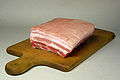 Pork belly
 -
 Braised pork belly
 -
 Pork belly with beans and dumplings
 -
 Pork belly char siu with rice
 -
 Lechong kawali


.jpg)


