Traumatic cardiac arrest: Difference between revisions
CSV import |
CSV import |
||
| Line 54: | Line 54: | ||
[[Category:Emergency medicine]] | [[Category:Emergency medicine]] | ||
[[Category:Traumatology]] | [[Category:Traumatology]] | ||
<gallery> | |||
File:Human_heart_male_adult_autopsy.jpg|Human heart from an adult male autopsy | |||
File:Pulseless_electrical_activity_EKG.svg|Pulseless electrical activity EKG | |||
File:EKG_Asystole.jpg|EKG showing asystole | |||
File:Echocardiogram_4chambers.jpg|Echocardiogram showing four chambers of the heart | |||
</gallery> | |||
Revision as of 04:35, 18 February 2025
Traumatic Cardiac Arrest

Traumatic cardiac arrest is a condition where the heart stops beating due to a severe physical injury. This type of cardiac arrest is distinct from medical cardiac arrest, which is caused by medical conditions such as a heart attack. Traumatic cardiac arrest can result from various types of trauma, including blunt force, penetrating injuries, or a combination of both.
Causes
Traumatic cardiac arrest can be caused by:
- Blunt trauma: This includes injuries from car accidents, falls, or assaults that cause significant impact to the body.
- Penetrating trauma: Injuries such as stab wounds or gunshot wounds that penetrate the body and damage internal organs.
- Hypovolemia: Severe blood loss leading to insufficient blood volume to maintain circulation.
- Tension pneumothorax: Air trapped in the pleural space causing lung collapse and impaired venous return to the heart.
- Cardiac tamponade: Accumulation of fluid in the pericardial sac, compressing the heart and preventing it from filling properly.
Diagnosis
Diagnosis of traumatic cardiac arrest involves:
- Physical examination: Assessing for signs of life, such as movement, breathing, or pulse.
- Electrocardiogram (ECG):
*

*

*

Treatment
The treatment of traumatic cardiac arrest focuses on addressing the underlying cause of the arrest. Key interventions include:
- Advanced trauma life support (ATLS) protocols.
- Chest compressions and cardiopulmonary resuscitation (CPR).
- Fluid resuscitation to restore blood volume.
- Decompression of tension pneumothorax using a needle or chest tube.
- Pericardiocentesis to relieve cardiac tamponade.
- Surgical intervention for repair of internal injuries.
Prognosis
The prognosis for traumatic cardiac arrest is generally poor, with survival rates significantly lower than those for medical cardiac arrest. However, rapid and appropriate intervention can improve outcomes in some cases.
Related Pages
References
<references group="" responsive="1"></references>
-
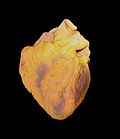 Human heart from an adult male autopsy
 -
 Pulseless electrical activity EKG
 -
 EKG showing asystole
 -
 Echocardiogram showing four chambers of the heart
