Friedrich Schleiermacher: Difference between revisions
CSV import |
CSV import |
||
| Line 41: | Line 41: | ||
[[Category:Philosophers of religion]] | [[Category:Philosophers of religion]] | ||
[[Category:19th-century philosophers]] | [[Category:19th-century philosophers]] | ||
<gallery> | |||
File:Friedrich_Daniel_Ernst_Schleiermacher.jpg|Portrait of Friedrich Schleiermacher | |||
File:Friedrich_Daniel_Ernst_Schleiermacher_2.jpg|Another portrait of Friedrich Schleiermacher | |||
File:Schleiermacher-Strasbourg.jpg|Schleiermacher in Strasbourg | |||
File:20220514_Dreifaltigkeitsfriedhof_II,_Grab_Friedrich_Schleiermacher.jpg|Grave of Friedrich Schleiermacher | |||
</gallery> | |||
Latest revision as of 04:28, 18 February 2025
Friedrich Schleiermacher[edit]
Friedrich Daniel Ernst Schleiermacher (21 November 1768 – 12 February 1834) was a German theologian, philosopher, and biblical scholar known for his efforts to reconcile the criticisms of the Enlightenment with traditional Protestant Christianity. He is often considered the "father of modern liberal theology" and made significant contributions to the fields of hermeneutics, philosophy of religion, and ethics.
Early Life and Education[edit]
Schleiermacher was born in Breslau, in the Kingdom of Prussia (now Wrocław, Poland). He was raised in a religious family and initially educated in the Moravian Brethren community, which emphasized personal piety and communal living. However, Schleiermacher found the Moravian doctrines too restrictive and left the community to pursue a broader education.
He studied at the University of Halle, where he was influenced by the works of Immanuel Kant and the German Enlightenment. Schleiermacher's early exposure to diverse philosophical ideas shaped his later theological and philosophical work.
Theological Contributions[edit]
Schleiermacher's most influential work is "On Religion: Speeches to Its Cultured Despisers" (1799), where he argued that religion is rooted in a feeling of absolute dependence on the divine, rather than in dogma or moral law. This work was aimed at the educated elite who had become skeptical of traditional religious beliefs.
In his "The Christian Faith" (1821-1822), Schleiermacher developed his systematic theology, emphasizing the importance of religious experience and the community of believers. He sought to present Christianity as a living faith that could adapt to modern intellectual challenges.
Contributions to Hermeneutics[edit]
Schleiermacher is also renowned for his work in hermeneutics, the theory and methodology of interpretation. He proposed that understanding a text requires both grammatical and psychological interpretation, considering the historical context and the author's intent. His ideas laid the groundwork for modern hermeneutics and influenced later thinkers such as Hans-Georg Gadamer.
Philosophy of Religion[edit]
In the philosophy of religion, Schleiermacher is known for his concept of "Gefühl" (feeling) as the essence of religion. He argued that religious feeling is a direct, immediate consciousness of the divine, which precedes doctrinal formulations. This approach shifted the focus from external religious practices to internal spiritual experiences.
Legacy and Influence[edit]
Schleiermacher's work had a profound impact on 19th-century theology and philosophy. He influenced the development of liberal Christianity, which seeks to reconcile religious faith with modern scientific and philosophical insights. His ideas also contributed to the rise of existentialism and the emphasis on individual experience in religious life.
Selected Works[edit]
- "On Religion: Speeches to Its Cultured Despisers" (1799)
- "The Christian Faith" (1821-1822)
- "Brief Outline of the Study of Theology" (1811)
See Also[edit]
References[edit]
- Barth, Karl. "Protestant Theology in the Nineteenth Century: Its Background and History." SCM Press, 2002.
- Crouter, Richard. "Friedrich Schleiermacher: Between Enlightenment and Romanticism." Cambridge University Press, 2005.
-
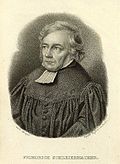 Portrait of Friedrich Schleiermacher
 -
 Another portrait of Friedrich Schleiermacher
 -
 Schleiermacher in Strasbourg
 -
 Grave of Friedrich Schleiermacher


