Greater petrosal nerve: Difference between revisions
CSV import |
CSV import |
||
| Line 31: | Line 31: | ||
{{anatomy-stub}} | {{anatomy-stub}} | ||
{{medicine-stub}} | {{medicine-stub}} | ||
<gallery> | |||
File:Gray789.png|Greater petrosal nerve | |||
File:Gray841.png|Greater petrosal nerve | |||
File:Head_lateral_gr_petrosal_nerve.jpg|Greater petrosal nerve | |||
File:Autonomic_Innervation_to_the_Lacrimal_Gland_(and_other_glands_of_the_deep_face).svg|Greater petrosal nerve | |||
</gallery> | |||
Latest revision as of 04:27, 18 February 2025
Greater Petrosal Nerve
The Greater Petrosal Nerve is a nerve in the human body that is part of the facial nerve system. It is responsible for carrying parasympathetic fibers to the lacrimal gland, as well as to the mucous membranes of the nasal cavity and palate.
Anatomy[edit]
The Greater Petrosal Nerve originates from the facial nerve in the facial canal, just after the nerve's geniculate ganglion. It then travels through the petrous part of the temporal bone, exiting through the greater petrosal foramen to enter the middle cranial fossa.
Function[edit]
The Greater Petrosal Nerve carries parasympathetic fibers that stimulate the secretion of tears from the lacrimal gland. It also carries fibers that stimulate the secretion of mucus from the mucous membranes of the nasal cavity and palate. In addition, it carries taste fibers from the palate.
Clinical Significance[edit]
Damage to the Greater Petrosal Nerve can result in a variety of symptoms, including dry eye syndrome, due to a lack of tear production, and loss of taste on the anterior two-thirds of the tongue. It can also lead to dry mouth and difficulty swallowing due to reduced salivation.
See Also[edit]
References[edit]
<references group="" responsive="1"></references>


-
 Greater petrosal nerve
 -
 Greater petrosal nerve
 -
 Greater petrosal nerve
 -
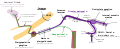 Greater petrosal nerve


.svg)
