Central pattern generator: Difference between revisions
CSV import |
CSV import |
||
| Line 37: | Line 37: | ||
{{Robotics-stub}} | {{Robotics-stub}} | ||
{{Medicine-stub}} | {{Medicine-stub}} | ||
<gallery> | |||
File:Intrinsic_properties_of_CPG_neurons.svg|Intrinsic properties of CPG neurons | |||
File:Mechanisms_of_rhythm_generation_in_CPGs.svg|Mechanisms of rhythm generation in CPGs | |||
File:Locomotor_CPG_schematic.jpg|Locomotor CPG schematic | |||
</gallery> | |||
Latest revision as of 04:27, 18 February 2025
Central pattern generator (CPG) is a neural network that can produce rhythmic patterned outputs without requiring rhythmic sensory or central nervous system (CNS) input. It is the primary mechanism that allows for the coordination of movement in all animal locomotion.
Overview[edit]
The concept of the central pattern generator was first proposed in the early 20th century, when scientists observed that the locomotion patterns of decapitated chickens remained unchanged. This led to the hypothesis that the control of movement might be generated by circuits located within the spinal cord rather than the brain.
CPGs are characterized by their ability to function autonomously. They can generate rhythmic activity in the absence of rhythmic input, although they can be modulated by extrinsic input. This allows for a wide range of adaptive responses to changes in the environment or the internal state of the animal.
Function[edit]
Central pattern generators are responsible for the rhythmic motor patterns that control various rhythmic activities such as walking, swimming, breathing, and chewing. They are found in the spinal cord, the brainstem, and in many parts of the brain.
The exact mechanisms by which CPGs function are not fully understood. However, it is known that they involve complex interactions between excitatory and inhibitory neurons, as well as feedback mechanisms that allow for the adjustment of the rhythm based on sensory input.
Research and Clinical Significance[edit]
Research into central pattern generators has implications for a variety of fields, including neuroscience, physiology, robotics, and medicine. Understanding the workings of CPGs could lead to new treatments for conditions such as Parkinson's disease, stroke, and spinal cord injury, where normal movement patterns are disrupted.
In the field of robotics, CPGs have been used as a model for developing autonomous robots that can adapt to changes in their environment. This has potential applications in areas such as search and rescue, exploration, and transportation.
See Also[edit]
References[edit]
<references />

This article is a neuroscience stub. You can help WikiMD by expanding it!

This physiology-related article is a stub. You can help WikiMD by expanding it.


-
 Intrinsic properties of CPG neurons
 -
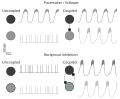 Mechanisms of rhythm generation in CPGs
 -
 Locomotor CPG schematic


