Phosphorite: Difference between revisions
CSV import Tags: mobile edit mobile web edit |
CSV import |
||
| Line 29: | Line 29: | ||
{{Geology-stub}} | {{Geology-stub}} | ||
{{Environment-stub}} | {{Environment-stub}} | ||
<gallery> | |||
File:Peloidal_phosphorite_Phosphoria_Formation_Simplot_Mine_Idaho.jpg|Peloidal phosphorite from Phosphoria Formation, Simplot Mine, Idaho | |||
File:Fossiliferous_peloidal_phosphorite,_Yunnan_Province_China.jpg|Fossiliferous peloidal phosphorite, Yunnan Province, China | |||
File:Estonian_shelly_phosphorites.jpg|Estonian shelly phosphorites | |||
File:DSCN5766-guano-glantz_crop_b.jpg|Phosphorite | |||
File:Phosphorite_Mine_Oron_Israel_070313.jpg|Phosphorite Mine, Oron, Israel | |||
</gallery> | |||
Latest revision as of 04:24, 18 February 2025
Phosphorite, also known as phosphate rock, is a sedimentary rock that contains high amounts of phosphate minerals. The phosphate content in phosphorites is primarily in the form of apatite, a calcium phosphate mineral. Phosphorites are used as a raw material for the production of phosphoric acid, fertilizers, animal feed supplements, and various chemicals.
Formation[edit]
Phosphorites form in a variety of marine settings, including continental shelves, upwelling zones, and around oceanic islands. Their formation is often linked to the concentration of phosphate during the chemical precipitation from seawater or the accumulation of phosphate-rich organic material. The process can be influenced by factors such as changes in sea level, oceanic circulation, and the productivity of marine ecosystems.
Types[edit]
There are several types of phosphorite deposits, including:
- Sedimentary phosphorites: Formed from the accumulation of phosphate particles in marine environments.
- Guano phosphorites: Created from the accumulation of bird or bat guano, which is rich in phosphates.
- Biogenic phosphorites: Formed from the remains of marine organisms that contain high levels of phosphate.
Uses[edit]
Phosphorites are primarily used for the production of phosphate fertilizers, which are essential for plant growth. They are also used in the manufacture of food additives, detergents, and various industrial products. In addition, phosphorites have applications in the field of environmental remediation, as they can be used to remove contaminants from wastewater.
Mining and Economic Importance[edit]
The mining of phosphorite is a significant industry in several countries, including the United States, China, and Morocco, which are among the world's largest producers of phosphate rock. The demand for phosphorites is driven by the agricultural sector's need for fertilizers to support crop production. However, the mining and processing of phosphorites can have environmental impacts, including water pollution and habitat destruction.
Environmental Concerns[edit]
The extraction and processing of phosphorite can lead to environmental issues such as the release of pollutants into water bodies and the atmosphere. There is also concern about the sustainability of phosphorite mining, as phosphate rock is a non-renewable resource. Efforts are being made to develop more sustainable practices in the phosphorite industry, including the recycling of phosphorus from waste sources.
See Also[edit]


This article is a environment-related stub. You can help WikiMD by expanding it!
-
 Peloidal phosphorite from Phosphoria Formation, Simplot Mine, Idaho
 -
 Fossiliferous peloidal phosphorite, Yunnan Province, China
 -
 Estonian shelly phosphorites
 -
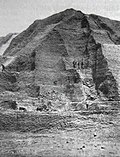 Phosphorite
 -
 Phosphorite Mine, Oron, Israel


