Entamoeba gingivalis: Difference between revisions
CSV import Tags: mobile edit mobile web edit |
CSV import |
||
| Line 25: | Line 25: | ||
{{Medicine-stub}} | {{Medicine-stub}} | ||
<gallery> | |||
File:Parasite130116-1-olm_Entamoeba_gingivalis_microscopy.tif|Entamoeba gingivalis microscopy | |||
File:Entamoeba_gingivalis.jpg|Entamoeba gingivalis | |||
File:Phagocytose_Entamoeba_gingivalis-PMN.ogv|Entamoeba gingivalis phagocytosis | |||
</gallery> | |||
Latest revision as of 04:21, 18 February 2025
Entamoeba gingivalis is a species of amoebae that is primarily found in the human mouth, residing in the gingival pockets near the base of the teeth. It is notable for being the first amoeba in humans to be described, with its discovery dating back to 1849 by Gros. Unlike its relative Entamoeba histolytica, which can cause the disease amoebiasis, E. gingivalis is not known to be a pathogenic amoeba, meaning it does not typically cause disease in humans.
Characteristics[edit]
Entamoeba gingivalis is a non-flagellated, non-cyst-forming amoeba, which differentiates it from other species of Entamoeba. It measures approximately 10 to 35 micrometers in diameter and exhibits a granular endoplasm. The amoeba feeds on bacteria and other debris found within the oral cavity, particularly in the gingival pockets surrounding the teeth. Its presence is often associated with poor oral hygiene and periodontal disease, although it does not directly cause these conditions.
Life Cycle[edit]
The life cycle of Entamoeba gingivalis is relatively simple compared to other protozoans, as it does not form cysts and exists solely in the trophozoite form. Transmission occurs through direct contact, often via saliva or dental procedures. Due to its habitat being restricted to the oral cavity, it does not undergo the complex life cycle stages seen in other Entamoeba species, which involve cyst formation and fecal-oral transmission.
Clinical Significance[edit]
While Entamoeba gingivalis is not considered pathogenic, its presence is often indicative of poor oral health. It has been found in higher concentrations in individuals with gum disease, such as gingivitis and periodontitis, suggesting a correlation between E. gingivalis colonization and oral health conditions. However, it is not clear whether the amoeba contributes to the progression of these diseases or simply thrives in the altered environment caused by them.
Diagnosis and Treatment[edit]
Diagnosis of Entamoeba gingivalis infection is typically made through microscopic examination of dental plaque or gingival pocket material. Special stains may be used to differentiate E. gingivalis from other oral amoebae and bacteria. Treatment is not usually necessary for E. gingivalis itself, but maintaining good oral hygiene and treating any underlying periodontal disease is important for overall oral health.
Prevention[edit]
Preventive measures against Entamoeba gingivalis colonization include regular dental check-ups, proper oral hygiene practices such as brushing and flossing, and avoiding the sharing of utensils or other items that may come into contact with saliva. These measures can also help prevent a range of other oral health issues.
See Also[edit]

-
 Entamoeba gingivalis microscopy
 -
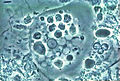 Entamoeba gingivalis
 -
 Entamoeba gingivalis phagocytosis

