Tudor food and drink: Difference between revisions
CSV import |
CSV import |
||
| Line 45: | Line 45: | ||
[[Category:Tudor England]] | [[Category:Tudor England]] | ||
[[Category:History of food and drink]] | [[Category:History of food and drink]] | ||
<gallery> | |||
File:Sprigs_of_Parsley.jpg|Sprigs of Parsley | |||
File:FoodTable.JPG|Tudor Food Table | |||
File:Tudor_pies_on_pewter_plates_at_Hampton_Court.JPG|Tudor pies on pewter plates at Hampton Court | |||
</gallery> | |||
Latest revision as of 04:00, 18 February 2025
Tudor Food and Drink[edit]


Tudor food and drink were characterized by a rich variety of ingredients and elaborate preparation methods, reflecting the social and economic changes of the Tudor period in England. The diet of the Tudor people varied significantly between the wealthy and the poor, with the former enjoying a wide range of meats and imported goods, while the latter relied more on local produce and simpler fare.
Ingredients and Dishes[edit]
Meats and Fish[edit]
The wealthy Tudors consumed a large amount of meat, including beef, pork, lamb, and venison. Game birds such as pheasant, partridge, and swan were also popular. Fish was a staple, especially on Fridays and during Lent, when meat consumption was restricted. Common fish included herring, cod, and salmon.
Fruits and Vegetables[edit]
Fruits and vegetables were less prominent in the Tudor diet, especially among the upper classes. However, they did consume apples, pears, plums, and cherries. Vegetables such as cabbage, onions, and leeks were more common among the lower classes.
Grains and Bread[edit]
Bread was a staple food for all classes, with the quality of bread varying according to social status. The wealthy ate fine white bread made from wheat, while the poor consumed coarser bread made from rye or barley.
Spices and Seasonings[edit]
Spices were highly prized and used extensively in Tudor cooking. Pepper, cinnamon, cloves, and nutmeg were imported and used to flavor dishes. Herbs such as parsley, sage, and rosemary were also common.
Beverages[edit]
Ale and Beer[edit]
Ale was the most common drink in Tudor England, consumed by all classes. It was often brewed at home and was a staple of the diet. Beer, which included hops, became increasingly popular during this period.
Wine[edit]
Wine was primarily consumed by the wealthy, with varieties imported from France, Spain, and Italy. Sack, a type of fortified wine, was particularly popular.
Other Drinks[edit]
Mead, made from honey, and cider, made from apples, were also consumed, though less frequently than ale and wine.
Social and Cultural Aspects[edit]
Food and drink played a significant role in Tudor society, with elaborate feasts and banquets serving as displays of wealth and power. The Tudor court was known for its extravagant meals, often featuring multiple courses and a wide array of dishes.
Related Pages[edit]
<references group="" responsive="1"></references>
-
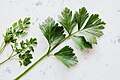 Sprigs of Parsley
 -
 Tudor Food Table
 -
 Tudor pies on pewter plates at Hampton Court
