Food deserts by country: Difference between revisions
CSV import |
CSV import |
||
| Line 27: | Line 27: | ||
{{Urban-stub}} | {{Urban-stub}} | ||
{{Sustainability-stub}} | {{Sustainability-stub}} | ||
<gallery> | |||
File:A_local_fruit_Vendor_in_the_old_town.jpg|A local fruit vendor in the old town | |||
File:Data_on_food_deserts.png|Data on food deserts | |||
File:Baltimorepiechart.jpg|Baltimore pie chart | |||
</gallery> | |||
Latest revision as of 03:53, 18 February 2025
Food deserts by country refers to the geographical areas, particularly in developed countries, where residents have limited access to affordable and nutritious food. This is largely due to a lack of grocery stores, farmers' markets, and healthy food providers. The concept of food deserts is a critical issue in the field of public health, urban planning, and sustainability.
Definition[edit]
A food desert is a region in which it is difficult to buy affordable or good-quality fresh food. These areas are often characterized by having a high concentration of convenience stores and fast food outlets, and a lack of supermarkets providing fresh fruits, vegetables, and other healthy food options.
Food Deserts in the United States[edit]
In the United States, food deserts are prevalent in both urban and rural areas. The United States Department of Agriculture (USDA) estimates that 23.5 million Americans live in food deserts. These areas are often found in low-income neighborhoods, where residents may also lack transportation to access supermarkets in other areas.
Food Deserts in the United Kingdom[edit]
In the United Kingdom, the concept of food deserts has been recognized since the 1990s. A study by the University of Sheffield found that those living in poorer areas of the country have access to fewer healthy food options compared to those in wealthier areas.
Food Deserts in Australia[edit]
Australia also faces the issue of food deserts, particularly in remote and rural areas. The lack of access to affordable, nutritious food contributes to the high rates of obesity and other diet-related diseases in these regions.
Food Deserts in Canada[edit]
In Canada, food deserts are often found in Northern and remote communities, where the cost of transporting food can make it prohibitively expensive. This issue is particularly acute in Indigenous communities.
Solutions[edit]
Various solutions have been proposed to address the issue of food deserts, including the development of community gardens, farmers' markets, and initiatives to attract supermarkets to underserved areas. Policies and programs aimed at improving food security and promoting healthy eating are also critical.

This article is a Public health stub. You can help WikiMD by expanding it!
This urban-related article is a stub. You can help WikiMD by expanding it.

This article is a sustainability-related stub. You can help WikiMD by expanding it!
-
 A local fruit vendor in the old town
 -
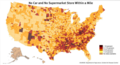 Data on food deserts
 -
 Baltimore pie chart


